
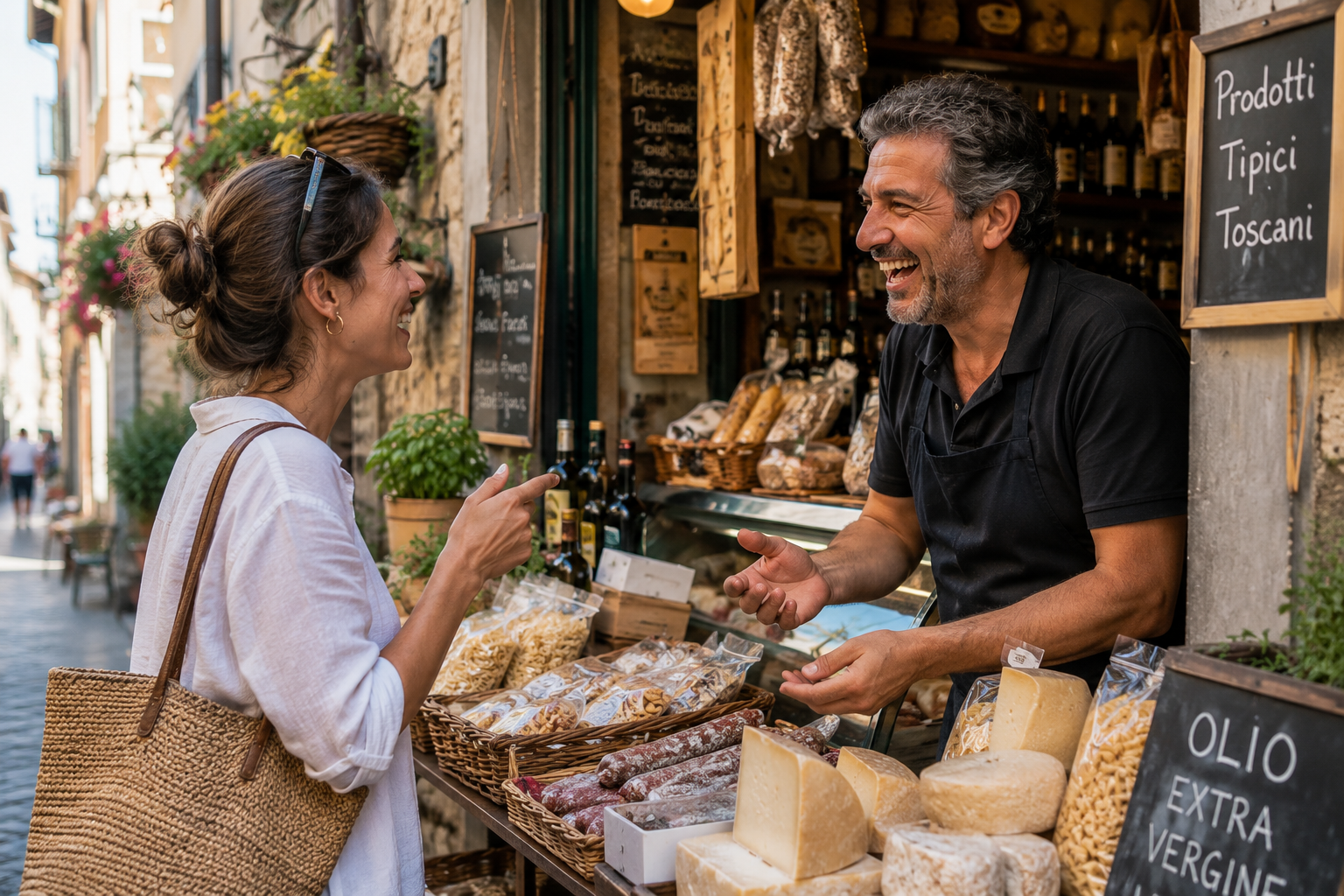
So you’re heading to Italy. Smart move, and even smarter that you’re looking up phrases before you land.
Here’s the thing most travel guides won’t tell you upfront: Italians don’t expect you to speak Italian.
What they do expect, and what makes the entire difference between a cold shoulder and a warm welcome, is that you try.
A stumbled “Buongiorno” with a smile unlocks more doors in Italy than perfect English ever will.
This guide gives you every basic Italian phrase for travel you actually need, organized by real-life situations so you can find what you want fast.
No fluff, no filler — just the phrases, the pronunciation, and the cultural context that make them land correctly.
Before you Memorize a Single Phrase: The One Rule That Changes Everything
There is a social rule in Italy that no phrasebook covers adequately, and it explains more confusing interactions tourists have than anything else.
When you walk into any shop, bar, café, or market stall in Italy, you must greet the person behind the counter. Every single time.
In the UK or US, walking into a boutique, browsing silently, and leaving is considered politely giving the worker space.
In Italy, it is considered the height of rudeness! Essentially, treating someone like they don’t exist.
A simple “Buongiorno” (during the day) or “Buonasera” (from late afternoon) when you walk in is not just a greeting. It is a social passport.
The moment you acknowledge the person, the cultural barrier drops. They will see that you’re trying, notice your accent immediately, and most of the time, switch to English to make your life easier.
One traveler in Rome stumbled through saying “Buongiorno! Posso comprare un giornale?” (Good morning! Can I buy a newspaper?) to a kiosk owner.
He was so delighted by the effort that he kissed her hand.
Imperfect Italian, delivered with warmth, beats perfect English delivered with cold efficiency every time.
The golden rule: Open in Italian. They’ll meet you in English.
Section 1: Basic Italian Phrases: Greetings & Essentials
These are the foundational Italian words for tourists. Get these right and you’ve handled the majority of daily interactions.
| English | Italian | Pronunciation |
| Good morning | Buongiorno | Bwohn-johr-noh |
| Good afternoon / evening | Buonasera | Bwoh-nah-seh-rah |
| Good night | Buonanotte | Bwoh-nah-noht-teh |
| Hi / Bye (informal) | Ciao | Chow |
| Goodbye (formal) | Arrivederci | Ah-ree-veh-dehr-chee |
| Please | Per favore | Pehr fah-voh-reh |
| Thank you | Grazie | Grah-tsee-eh |
| You’re welcome | Prego | Preh-goh |
| Excuse me (for attention) | Scusi | Skoo-zee |
| Excuse me (to pass by) | Permesso | Pehr-mehs-soh |
| I’m sorry | Mi dispiace | Mee dees-pyah-cheh |
| Yes | Sì | See |
| No | No | Noh |
| I don’t understand | Non capisco | Non kah-pee-skoh |
| I don’t speak Italian | Non parlo italiano | Non pahr-loh ee-tah-lyah-noh |
| My name is… | Mi chiamo… | Mee kyah-moh |
| Pleased to meet you | Piacere | Pyah-cheh-reh |
What does "ciao tutti" mean?

"Ciao tutti" means "Hi everyone" or "Bye everyone" in Italian, used as a friendly greeting or farewell when addressing a group.
It's casual and best suited to informal settings — greeting friends at a gathering or signing off in a group chat. For formal groups, use "Buongiorno a tutti" instead.
The “Ciao” Question: When Is It Actually OK?
Every tourist loves ciao. It feels fun and friendly.
But here’s what the phrasebooks skip: using ciao with adult strangers, shopkeepers, or waiters can come across as presumptuous, almost like you’re talking down to them.
The safe rule: default to formal greetings with anyone you don’t know.
Use Buongiorno/Buonasera when you arrive, Arrivederci when you leave. If the local uses ciao with you first, then it’s absolutely fine to mirror it.
In tourist-heavy, younger, or lively bar settings, ciao is relaxed. But let the Italian lead.
What does "che cosa" mean?

"Che cosa" means "what" in Italian — literally "what thing." Italians often shorten it to just "che" or just "cosa" in casual conversation, and all three forms are correct.
For example: "Che cosa vuoi?" / "Che vuoi?" / "Cosa vuoi?" all mean "What do you want?"
Section 2: Asking for Help & Getting Around
These are the common Italian phrases for travel that will save you when you’re lost, confused, or need clarification.
| English | Italian | Pronunciation |
| Do you speak English? | Parla inglese? | Pahr-lah een-gleh-zeh? |
| Can you speak slower, please? | Può parlare più lentamente? | Pwoh pahr-lah-reh pyoo len-tah-men-teh? |
| Can you write it down? | Può scriverlo? | Pwoh skree-vehr-loh? |
| Can you help me? | Mi può aiutare? | Mee pwoh ah-yoo-tah-reh? |
| I don’t understand | Non capisco | Non kah-pee-skoh |
| Can you repeat that? | Può ripetere? | Pwoh ree-peh-teh-reh? |
| Where is…? | Dov’è…? | Doh-veh…? |
| I’m looking for… | Cerco… | Chehr-koh… |
What is tutto bene?

"Tutto bene" means "all is well" or "everything's fine" in Italian.
It's used both as a question: "Tutto bene?" ("Everything OK?"), and as a reassuring response.
It's one of the most useful conversational phrases for travelers, perfect for casual check-ins or letting someone know you're alright.
The “Do You Speak English?” Trap
Asking “Parla inglese?” perfectly in Italian creates a funny problem: if they don’t speak English, it’s just awkward.
If you ask it flawlessly, they’ll assume you speak more Italian than you do and answer you in rapid-fire Italian.
A more practical approach: use a polite “Scusi…” to get attention, wait for eye contact, then simply say “English?” while pointing to yourself. Or say “Solo inglese” (only English).
It’s clearer, lower stakes, and just as respectful.
Section 3: Asking for Directions
Getting lost in Italian cities is part of the experience. These basic Italian words for tourists will help you find your way.
| English | Italian | Pronunciation |
| Where is…? | Dov’è…? | Doh-veh…? |
| Left | Sinistra | See-nee-strah |
| Right | Destra | Deh-strah |
| Straight ahead | Dritto | Dree-toh |
| Turn | Girare | Jee-rah-reh |
| Near / Far | Vicino / Lontano | Vee-chee-noh / Lon-tah-noh |
| Here / There | Qui / Là | Kwee / Lah |
| At the corner | All’angolo | Ahl-ahn-goh-loh |
| Traffic light | Semaforo | Seh-mah-foh-roh |
| Street / Square | Via / Piazza | Vee-ah / Pyah-tzah |
Pro tip: When you ask for directions, watch the person’s hands. Italians gesture directionally and often the physical motion is clearer than the words. Follow the hands.
Section 4: Transport Phrases
Whether you’re navigating trains, buses, or taxis, these Italian words for traveling will keep you moving.
Train & Bus
| English | Italian | Pronunciation |
| Where is the train station? | Dov’è la stazione? | Doh-veh lah stah-tsyoh-neh? |
| Where is the bus stop? | Dov’è la fermata dell’autobus? | Doh-veh lah fehr-mah-tah del-ow-toh-boos? |
| One ticket, please | Un biglietto, per favore | Oon beel-yeh-toh, pehr fah-voh-reh |
| One way | Solo andata | Soh-loh ahn-dah-tah |
| Return | Andata e ritorno | Ahn-dah-tah eh ree-tohr-noh |
| Which platform for Rome? | Da quale binario per Roma? | Dah kwah-leh bee-nah-ryoh pehr Roh-mah? |
| Is this seat taken? | È occupato? | Eh ok-koo-pah-toh? |
| Does this train stop at…? | Questo treno ferma a…? | Kweh-stoh treh-noh fehr-mah ah…? |
| I missed my train | Ho perso il treno | Oh pehr-soh eel treh-noh |
Taxi
| English | Italian | Pronunciation |
| Take me to… | Mi porti a… | Mee pohr-tee ah… |
| How much to get to…? | Quanto costa andare a…? | Kwahn-toh koh-stah ahn-dah-reh ah…? |
| Stop here, please | Si fermi qui, per favore | See fehr-mee kwee, pehr fah-voh-reh |
| Can you give me a receipt? | Può darmi la ricevuta? | Pwoh dahr-mee lah ree-cheh-voo-tah? |
Airport
| English | Italian | Pronunciation |
| Where is the check-in? | Dov’è il check-in? | Doh-veh eel check-in? |
| Where is baggage claim? | Dov’è il ritiro bagagli? | Doh-veh eel ree-tee-roh bah-gah-lyee? |
| My luggage is lost | Il mio bagaglio è perso | Eel myoh bah-gah-lyoh eh pehr-soh |
| Where is the exit? | Dov’è l’uscita? | Doh-veh loo-shee-tah? |
Section 5: Coffee Culture Phrases
This deserves its own section. Coffee in Italy is not just a drink, it is a ritual with rules.
Getting it wrong is a rite of passage; getting it right earns genuine respect.
| English | Italian | Pronunciation |
| A coffee, please (= espresso) | Un caffè, per favore | Oon kah-feh, pehr fah-voh-reh |
| A double espresso | Un caffè doppio | Oon kah-feh doh-pyoh |
| A white coffee / latte | Un cappuccino | Oon kah-poo-chee-noh |
| A long black (filter-style) | Un caffè americano | Oon kah-feh ah-meh-ree-kah-noh |
| Decaf | Un caffè decaffeinato | Oon kah-feh deh-kah-feh-ee-nah-toh |
| With milk | Con latte | Kon lah-teh |
| Without sugar | Senza zucchero | Sehn-tsah tsook-keh-roh |
| At the bar (standing) | Al banco | Ahl bahn-koh |
| A glass of water | Un bicchiere d’acqua | Oon beek-kyeh-reh dah-kwah |
3 Coffee Rules Every Traveler Needs to Know
1. “Un caffè” = espresso. Always. If you ask for a coffee and expect a big mug of filter coffee, you will be confused and the barista will be confused.
If you want something longer and milder, ask for an “americano.”
2. Cappuccino is a morning drink. Italians do not drink cappuccino after about 11am. Ordering one after lunch or with dinner will get you served without complaint, but it marks you as a tourist immediately.
If you want hot milk-based coffee in the afternoon, ask for a “caffè macchiato” (espresso with a splash of milk).
3. Standing at the bar is cheaper. The same coffee costs significantly less at the counter (al banco) than sitting at a table. Locals stand. It’s faster, cheaper, and more Italian.
Section 6: Restaurant & Dining Phrases
Food is the heart of Italian culture. These common Italian phrases for travel will carry you from the bread basket to the bill.
Getting Seated & Ordering
| English | Italian | Pronunciation |
| A table for two, please | Un tavolo per due, per favore | Oon tah-voh-loh pehr doo-eh, pehr fah-voh-reh |
| Can I reserve a table? | Posso prenotare un tavolo? | Pohs-soh preh-noh-tah-reh oon tah-voh-loh? |
| The menu, please | Il menù, per favore | Eel meh-noo, pehr fah-voh-reh |
| What do you recommend? | Cosa consiglia? | Koh-zah kon-see-lyah? |
| Today’s special? | Il piatto del giorno? | Eel pyah-toh del johr-noh? |
| I would like… | Vorrei… | Vohr-ray… |
| For me… | Per me… | Pehr meh… |
| Enjoy your meal! | Buon appetito! | Bwohn ah-peh-tee-toh! |
Dietary Needs and Food Preferences
| English | Italian | Pronunciation |
| I am allergic to… | Sono allergico/a a… | Soh-noh ah-lehr-jee-koh/kah ah… |
| I have an intolerance to… | Ho un’intolleranza a… | oh oon-een-tohl-leh-RAHN-tsah ah… |
| Gluten | Glutine | Gloo-tee-neh |
| Dairy | Latticini | Lah-tee-chee-nee |
| Milk | Latte | LAHT-teh |
| Nuts | Noci | Noh-chee |
| Eggs | Uova | WOH-vah |
| Butter | Burro | BOOR-roh |
| Shellfish | Crostacei | Kroh-stah-cheh-ee |
| Is this vegetarian? | È vegetariano? | Eh veh-jeh-tah-ryah-noh? |
| Is this vegan? | È vegano? | Eh veh-gah-noh? |
| I am vegan | Sono vegano/a | SOH-noh veh-GAH-noh/nah |
| Without meat | Senza carne | Sehn-tsah kahr-neh |
| Without fish | Senza pesce | Sehn-tsah peh-sheh |
| I am vegetarian | Sono vegetariano/a | SOH-noh veh-jeh-tah-RYAH-noh/nah |
| I am pescatarian | Sono pescetariano/a | SOH-noh peh-sheh-tah-RYAH-noh/nah |
| I eat lactose-free | Mangio senza lattosio | MAHN-joh SEN-tsah laht-TOH-zyoh |
| I eat gluten-free | Mangio senza glutine | MAHN-joh SEN-tsah GLOO-tee-neh |
| I don’t drink alcohol | Non bevo alcolici | non BEH-voh ahl-KOH-lee-chee |
What does cacio mean?

"Cacio" is an Italian word for cheese, specifically aged, hard cheeses like Pecorino Romano.
It's most famously used in the Roman pasta dish "cacio e pepe" (cheese and pepper), one of Rome's most iconic plates.
While "formaggio" is the everyday word for cheese, "cacio" carries a more traditional, regional flavor.
Questions to Ask at the Restaurant
| English | Italian | Pronunciation |
| Do you have vegetarian options? | Avete opzioni vegetariane? | ah-VEH-teh op-TSYOH-nee veh-jeh-tah-RYAH-neh? |
| Do you have gluten-free options? | Avete opzioni senza glutine? | ah-VEH-teh op-TSYOH-nee SEN-tsah GLOO-tee-neh? |
| Do you have lactose-free options? | Avete opzioni senza lattosio? | ah-VEH-teh op-TSYOH-nee SEN-tsah laht-TOH-zyoh? |
| Do you have non-alcoholic drinks? | Avete bevande senza alcool? | ah-VEH-teh beh-VAHN-deh SEN-tsah AHL-kohl? |
| Does this dish contain milk? | Questo piatto contiene latte? | KWES-toh PYAHT-toh kon-TYEH-neh LAHT-teh? |
| Does this dish contain eggs? | Questo piatto contiene uova? | KWES-toh PYAHT-toh kon-TYEH-neh WOH-vah? |
| Does this dish contain butter? | Questo piatto contiene burro? | KWES-toh PYAHT-toh kon-TYEH-neh BOOR-roh? |
Water, Wine & Drinks
| English | Italian | Pronunciation |
| Still water | Acqua naturale | Ah-kwah nah-too-rah-leh |
| Sparkling water | Acqua frizzante | Ah-kwah freet-sahn-teh |
| Tap water | Acqua del rubinetto | Ah-kwah del roo-bee-neht-toh |
| House wine | Vino della casa | Vee-noh dehl-lah kah-sah |
| Red / White wine | Vino rosso / bianco | Vee-noh rohs-soh / byahn-koh |
| A glass / bottle | Un bicchiere / una bottiglia | Oon beek-kyeh-reh / boh-teel-yah |
| More bread, please | Altro pane, per favore | Ahl-troh pah-neh, pehr fah-voh-reh |
Paying the Bill
| English | Italian | Pronunciation |
| The bill, please | Il conto, per favore | Eel kon-toh, pehr fah-voh-reh |
| Can we split the bill? | Possiamo dividere il conto? | Pohs-syah-moh dee-vee-deh-reh eel kon-toh? |
| Can I pay by card? | Posso pagare con la carta? | Pohs-soh pah-gah-reh kon lah kahr-tah? |
| Is service included? | Il servizio è incluso? | Eel sehr-vee-tsyoh eh een-kloo-zoh? |
3 Dining Situations That Confuse Tourists
The check won’t arrive automatically. In Italy, leaving the bill unbidden is considered rude, it implies you’re being rushed out.
To get it, you must ask. Catch the waiter’s eye and say “Il conto, per favore” or simply mime signing a check. This is non-negotiable knowledge.
The coperto is not a scam. Most restaurants charge a “coperto” (cover charge) of €1–3 per person. It covers your bread, table setting, and the right to sit.
It will appear on your bill. It’s completely normal and legal.
Tap water is fine to ask for. Restaurants in tourist areas almost always push bottled water (still or sparkling).
You are perfectly within your rights to ask for “acqua del rubinetto” (tap water). In many Italian cities, tap water is excellent quality.
Section 7: Accommodation Phrases
These are the basic Italian words for tourists that hotel-goers actually need.
| English | Italian | Pronunciation |
| I have a reservation | Ho una prenotazione | Oh oo-nah preh-noh-tah-tsyoh-neh |
| My name is… | Mi chiamo… | Mee kyah-moh… |
| Check-in / Check-out | Check-in / Check-out | (Same as English) |
| Is breakfast included? | La colazione è inclusa? | Lah koh-lah-tsyoh-neh eh een-kloo-zah? |
| What time is breakfast? | A che ora è la colazione? | Ah kay oh-rah eh lah koh-lah-tsyoh-neh? |
| My room is too hot/cold | La mia camera è troppo calda/fredda | Lah myah kah-meh-rah eh trohp-poh kahl-dah/fred-dah |
| The air conditioning doesn’t work | L’aria condizionata non funziona | Lah-ryah kon-dee-tsyoh-nah-tah non foon-tsyoh-nah |
| Can I have extra towels? | Posso avere asciugamani in più? | Pohs-soh ah-veh-reh ah-shoo-gah-mah-nee een pyoo? |
| What is the WiFi password? | Qual è la password del WiFi? | Kwahl eh lah pass-word del WiFi? |
| Can I have a wake-up call at…? | Posso avere una sveglia alle…? | Pohs-soh ah-veh-reh oo-nah zveh-lyah ahl-leh…? |
| I’d like a late check-out | Vorrei un check-out posticipato | Vohr-ray oon check-out pohs-tee-chee-pah-toh |
| Where is the elevator? | Dov’è l’ascensore? | Doh-veh lah-shen-soh-reh? |
Section 8: Shopping Phrases
Italy is one of the world’s great shopping destinations. These phrases will help you navigate markets, boutiques, and everything in between.
| English | Italian | Pronunciation |
| How much does this cost? | Quanto costa? | Kwahn-toh koh-stah? |
| It’s too expensive | È troppo caro | Eh trohp-poh kah-roh |
| Do you have something cheaper? | Ha qualcosa di meno caro? | Ah kwahl-koh-zah dee meh-noh kah-roh? |
| Can I try this on? | Posso provarlo? | Pohs-soh proh-vahr-loh? |
| Do you have this in size…? | Ce l’ha nella taglia…? | Cheh lah nehl-lah tah-lyah…? |
| I’ll take it | Lo prendo | Loh prehn-doh |
| I don’t want it | Non lo voglio | Non loh voh-lyoh |
| Can you ship to…? | Può spedire a…? | Pwoh speh-dee-reh ah…? |
| I’m just looking | Sto solo guardando | Stoh soh-loh gwahr-dahn-doh |
| Do you accept credit cards? | Accettate carte di credito? | Ah-cheht-tah-teh kahr-teh dee kreh-dee-toh? |
Note: At markets and smaller independent shops, gentle haggling is sometimes expected. At established boutiques and chain stores, prices are fixed. Use your judgment.
Section 9: Museum & Sightseeing Phrases
| English | Italian | Pronunciation |
| One adult ticket, please | Un biglietto adulto, per favore | Oon beel-yeh-toh ah-dool-toh, pehr fah-voh-reh |
| Two adults / one child | Due adulti / un bambino | Doo-eh ah-dool-tee / oon bahm-bee-noh |
| One student | Uno studente | Oo-noh stoo-den-teh |
| One senior | Un anziano | Oon ahn-tsyah-noh |
| When does it open/close? | Quando apre/chiude? | Kwahn-doh ah-preh / kyoo-deh? |
| Is photography allowed? | Si possono fare fotografie? | See pohs-soh-noh fah-reh foh-toh-grah-fee-eh? |
| Where is the cloakroom? | Dov’è il guardaroba? | Doh-veh eel gwahr-dah-roh-bah? |
| Is there an audio guide? | C’è un’audioguida? | Cheh oon ow-dyoh-gwee-dah? |
| Is it free? | È gratuito? | Eh grah-too-ee-toh? |
| Is it open on Sunday? | È aperto la domenica? | Eh ah-pehr-toh lah doh-meh-nee-kah? |
Section 10: Italian Holiday Phrases to Know for Travelers
Italians celebrate with warmth and ceremony.
Dropping one of these phrases at the right moment, whether during a birthday dinner, at a Christmas market in Rome, or on New Year’s Eve in a piazza, can create a connection that a simple “thank you” never could.
| English | Italian | Pronunciation |
|---|---|---|
| Happy New Year | Buon anno | Bwohn AHN-no |
| Merry Christmas | Buon Natale | Bwohn nah-TAH-leh |
| Happy Easter | Buona Pasqua | Bwoh-nah PAHS-kwah |
| Happy Birthday | Buon compleanno | Bwohn kom-pleh-AHN-no |
| Congratulations | Complimenti / Auguri | Kohm-plee-MEN-tee / Ow-GOO-ree |
| Best wishes | Tanti auguri | TAHN-tee ow-GOO-ree |
| Have a good holiday | Buone feste | Bwoh-neh FES-teh |
| Happy celebrations | Buona festa | Bwoh-nah FES-tah |
Travel tip: "Auguri" is one of the most versatile words in Italian celebrations. It literally means "best wishes" and is used for birthdays, holidays, and almost any celebratory occasion. When in doubt, "Tanti auguri!" covers nearly everything.
Section 11: Pharmacy Phrases
One of the most important and most overlooked sections in any Italian phrases guide.
Every traveler needs to know this, especially for minor emergencies.
| English | Italian | Pronunciation |
| Where is the pharmacy? | Dov’è la farmacia? | Doh-veh lah fahr-mah-chee-ah? |
| I need something for… | Ho bisogno di qualcosa per… | Oh bee-zoh-nyoh dee kwahl-koh-zah pehr… |
| Headache | Mal di testa | Mahl dee teh-stah |
| Stomach ache | Mal di stomaco | Mahl dee stoh-mah-koh |
| Fever | Febbre | Feh-breh |
| Cold / Flu | Raffreddore / Influenza | Rahf-fred-doh-reh / Een-floo-en-tsah |
| Diarrhea | Diarrea | Dee-ahr-reh-ah |
| Sore throat | Mal di gola | Mahl dee goh-lah |
| Sunburn | Scottatura solare | Skoht-tah-too-rah soh-lah-reh |
| I am allergic to… | Sono allergico/a a… | Soh-noh ah-lehr-jee-koh/kah ah… |
| Penicillin | Penicillina | Peh-nee-cheel-lee-nah |
| Do I need a prescription? | Ho bisogno di una ricetta? | Oh bee-zoh-nyoh dee oo-nah ree-cheht-tah? |
| Painkiller | Antidolorifico | Ahn-tee-doh-loh-ree-fee-koh |
| Bandage | Benda | Behn-dah |
| Antiseptic | Antisettico | Ahn-tee-seht-tee-koh |
Pharmacy tip: Italian pharmacies (farmacia, identified by a green cross sign) are remarkably well-stocked and pharmacists are highly trained.
They can recommend treatments for many common ailments without a doctor’s prescription. They’re often the fastest first stop for minor travel illnesses.
Section 12: For Women Travelers: Italian Phrases You Actually Need
| English | Italian | Pronunciation |
|---|---|---|
| Where is the nearest pharmacy? | Dov’è la farmacia più vicina? | Doh-veh lah far-mah-CHEE-ah pyoo vee-CHEE-nah? |
| I need sanitary pads | Ho bisogno di assorbenti | Oh bee-ZOH-nyoh dee as-sor-BEN-tee |
| I need tampons | Ho bisogno di tamponi | Oh bee-ZOH-nyoh dee tam-POH-nee |
| I need a panty liner | Ho bisogno di salvaslip | Oh bee-ZOH-nyoh dee sal-vah-SLEEP |
| I have menstrual cramps | Ho dolori mestruali | Oh doh-LOH-ree mes-troo-AH-lee |
| I need pain relief | Ho bisogno di antidolorifici | Oh bee-ZOH-nyoh dee an-tee-doh-loh-REE-fee-chee |
| I need a pregnancy test | Ho bisogno di un test di gravidanza | Oh bee-ZOH-nyoh dee oon test dee gra-vee-DAN-tsah |
| I need contraception | Ho bisogno di contraccettivi | Oh bee-ZOH-nyoh dee kon-tra-chet-TEE-vee |
| I need to see a female doctor | Ho bisogno di vedere una dottoressa | Oh bee-ZOH-nyoh dee veh-DEH-reh OO-nah dot-toh-RES-sah |
| Do I need a prescription? | Ho bisogno di una ricetta? | Oh bee-ZOH-nyoh dee OO-nah ree-CHET-tah? |
| Leave me alone | Mi lasci in pace | Mee LAH-shee een PAH-cheh |
| Go away | Vada via | VAH-dah VEE-ah |
| Help! | Aiuto! | Ah-YOO-toh! |
| Call the police | Chiami la polizia | KYAH-mee lah poh-LEE-tsyah |
| Is it safe here at night? | È sicuro qui di notte? | Eh see-KOO-roh kwee dee NOT-teh? |
Practical note: Italian pharmacies (farmacia, identified by a green cross) stock most feminine hygiene products.
Larger supermarkets (Esselunga, Conad, Carrefour) are often cheaper and better stocked for everyday items.
Pharmacists in tourist areas often speak basic English and are genuinely helpful for minor health questions.
Section 13: Emergency Phrases
Hope you never need these. Know them anyway.
| English | Italian | Pronunciation |
| Help! | Aiuto! | Ah-yoo-toh! |
| Call the police! | Chiami la polizia! | Kyah-mee lah poh-lee-tsee-ah! |
| Call an ambulance! | Chiami un’ambulanza! | Kyah-mee oon ahm-boo-lahn-tsah! |
| I need a doctor | Ho bisogno di un medico | Oh bee-zoh-nyoh dee oon meh-dee-koh |
| I’ve been robbed | Sono stato/a derubato/a | Soh-noh stah-toh/tah deh-roo-bah-toh/tah |
| My passport was stolen | Mi hanno rubato il passaporto | Mee ahn-noh roo-bah-toh eel pahs-sah-pohr-toh |
| I’m lost | Mi sono perso/a | Mee soh-noh pehr-soh/sah |
| Fire! | Fuoco! / Al fuoco! | Fwoh-koh! |
| Go away! | Vai via! | Vy vee-ah! |
| Look out! | Attento/a! | Aht-tehn-toh/tah! |
Emergency number in Italy: 112 (European emergency number, works for police, ambulance, and fire)
Section 14: Numbers, Time & Days
Numbers 1–20
| Number | Italian | Pronunciation |
| 1 | Uno | Oo-noh |
| 2 | Due | Doo-eh |
| 3 | Tre | Treh |
| 4 | Quattro | Kwah-troh |
| 5 | Cinque | Cheen-kweh |
| 6 | Sei | Say |
| 7 | Sette | Seht-teh |
| 8 | Otto | Oh-toh |
| 9 | Nove | Noh-veh |
| 10 | Dieci | Dee-eh-chee |
| 11 | Undici | Oon-dee-chee |
| 12 | Dodici | Doh-dee-chee |
| 13 | Tredici | Treh-dee-chee |
| 14 | Quattordici | Kwah-tohr-dee-chee |
| 15 | Quindici | Kween-dee-chee |
| 16 | Sedici | Seh-dee-chee |
| 17 | Diciassette | Dee-chah-seht-teh |
| 18 | Diciotto | Dee-choht-toh |
| 19 | Diciannove | Dee-chahn-noh-veh |
| 20 | Venti | Vehn-tee |
Key round numbers: 30 (trenta), 40 (quaranta), 50 (cinquanta), 100 (cento), 1000 (mille)
Telling the Time
| English | Italian | Pronunciation |
| What time is it? | Che ora è? | Kay oh-rah eh? |
| It is… o’clock | Sono le… | Soh-noh leh… |
| In the morning | Di mattina | Dee mah-tee-nah |
| In the afternoon | Di pomeriggio | Dee poh-meh-reed-joh |
| In the evening | Di sera | Dee seh-rah |
| Noon | Mezzogiorno | Mehd-dzoh-johr-noh |
| Midnight | Mezzanotte | Mehd-dzah-noht-teh |
Days of the Week
| English | Italian |
| Monday | Lunedì |
| Tuesday | Martedì |
| Wednesday | Mercoledì |
| Thursday | Giovedì |
| Friday | Venerdì |
| Saturday | Sabato |
| Sunday | Domenica |
| Today | Oggi |
| Tomorrow | Domani |
| Yesterday | Ieri |
Section 15: Italian Pronunciation Basics
One of the biggest advantages you can give yourself before your trip is understanding how Italian sounds.
You should start with C rule, which governs how the most common letter changes pronunciation.
What is the C rule in Italian?

The C rule in Italian governs how the letter "c" is pronounced based on the vowel that follows it. Before e or i, "c" sounds like "ch" in church (ciao = "chow").
Before a, o, or u, "c" sounds like "k" in cat (caffè = "kah-feh").
The same rule applies to the letter "g."
Unlike English, Italian pronunciation is almost entirely consistent, once you know the rules, you can pronounce almost any word correctly.
The core rule: every letter is pronounced. There are almost no silent letters in Italian.
Key Sounds to Know
| Letter/Combo | Sound | Example |
| c before e, i | “ch” as in church | Ciao = “chow” |
| c before a, o, u | “k” as in cat | Caffè = “kah-feh” |
| g before e, i | “j” as in jelly | Gelato = “jeh-lah-toh” |
| g before a, o, u | “g” as in go | Grazie = “grah-tsee-eh” |
| gli | like “lli” in “million” | Biglietto = “beel-yeh-toh” |
| gn | like “ny” in “canyon” | Buongiorno = “bwohn-johr-noh” |
| sc before e, i | “sh” as in shoe | Scusi = “skoo-zee” |
| z | “ts” as in pizza | Grazie = “grah-tsee-eh” |
Stress: In most Italian words, stress falls on the second-to-last syllable. Exceptions are shown with an accent mark (è, à, etc.).
Double consonants matter. “Anno” (year) is pronounced with a noticeably longer “n” than “ano.” Italians hear the difference, but don’t worry too much about perfecting this as a beginner.
Quick-Reference Cheat Sheet
Save or print this for your trip, your pocket survival kit of the most-used basic Italian phrases for tourists.
Essentials
| Situation | Italian |
| Entering any shop/bar | Buongiorno / Buonasera |
| Thank you | Grazie |
| Please | Per favore |
| Excuse me | Scusi |
| I don’t understand | Non capisco |
| Do you speak English? | Parla inglese? |
| Goodbye | Arrivederci |
Food & Drink
| Situation | Italian |
| Espresso | Un caffè |
| Filter/long coffee | Un americano |
| Still water | Acqua naturale |
| Sparkling water | Acqua frizzante |
| Tap water | Acqua del rubinetto |
| The bill | Il conto, per favore |
| Split the bill | Possiamo dividere il conto? |
| I’m allergic to… | Sono allergico/a a… |
Getting Around
| Situation | Italian |
| Where is…? | Dov’è…? |
| Left / Right / Straight | Sinistra / Destra / Dritto |
| Train station | La stazione |
| Bus stop | La fermata dell’autobus |
| One ticket | Un biglietto |
Hotel
| Situation | Italian |
| I have a reservation | Ho una prenotazione |
| WiFi password? | La password del WiFi? |
| Is breakfast included? | La colazione è inclusa? |
Pharmacy
| Situation | Italian |
| Where is the pharmacy? | Dov’è la farmacia? |
| I need something for a headache | Ho bisogno di qualcosa per il mal di testa |
| I need a doctor | Ho bisogno di un medico |
Emergency
| Situation | Italian |
| Help! | Aiuto! |
| Call the police! | Chiami la polizia! |
| Call an ambulance! | Chiami un’ambulanza! |
| Emergency number | 112 |
A Final Word: Imperfect Italian Beats Perfect Silence
You will mispronounce things. You will forget words mid-sentence. You will accidentally order two desserts when you meant to ask for the bill.
None of that matters. What matters is that you tried.
Italy is one of the most forgiving countries in the world for language learners, precisely because Italians are so emotionally invested in their own language.
When you make the effort, even a clumsy, accented, grammatically questionable effort, it communicates something that perfect English never could: I respect you enough to try speaking your language.
Start with the greeting. Let them do the rest. That’s all it takes.
Buon viaggio! (Safe travels!) ❤️❤️❤️
FAQ: Common Italian Phrases for Travel
1. What are the 5 W’s in Italian?
The 5 W’s in Italian are: Chi (Who), Cosa or Che (What), Quando (When), Dove (Where), and Perché (Why). A sixth essential question word is Come (How).
These six words form the backbone of nearly every conversation and are essential for asking about anything during your travels.
2. What are the most important basic Italian phrases for tourists to know?
The single most important phrase is a proper greeting: “Buongiorno” (good morning/day) or “Buonasera” (good evening) every time you enter a shop, café, or restaurant.
After that, the essentials are: Grazie (thank you), Scusi (excuse me), Per favore (please), Non capisco (I don’t understand), and Il conto, per favore (the bill, please). These six phrases will handle the vast majority of daily interactions.
3. What are the most useful Italian words to know when traveling?
Focus on category-specific vocabulary rather than random words.
The most useful single words to know when traveling in Italy are: dov’è (where is), vorrei (I would like), quanto (how much), sinistra/destra (left/right), biglietto (ticket), farmacia (pharmacy), and conto (bill). These words unlock full phrases even when your grammar isn’t perfect.
4. Is “Ciao” OK to use with strangers in Italy?
With caution. “Ciao” is informal and using it with adult strangers, shopkeepers, or waiters can come across as presumptuous in more traditional or older contexts.
The safest approach is to greet with “Buongiorno” or “Buonasera” with anyone you don’t know, and let the Italian lower the register to ciao first. In tourist-heavy, younger, or lively bar settings, ciao is perfectly fine.
5. Do I really need to learn Italian phrases if most Italians in tourist areas speak English?
Yes, but not for the reason you think. You’re not learning phrases because Italians can’t speak English. You’re learning them because the way you approach Italians changes everything.
Opening with an Italian greeting signals respect and warmth. They notice the effort immediately, and almost always switch to English to help you. The phrases are social lubricant, not a translation tool.
6. What are basic Italian words for tourists visiting markets and shops?
For shopping, the essential basic Italian words for tourists are: Quanto costa? (How much?), Troppo caro (too expensive), Posso provarlo? (Can I try it on?), Lo prendo (I’ll take it), and Sto solo guardando (I’m just looking).
At open-air markets, gentle haggling is sometimes expected; at established boutiques, prices are fixed.
7. What should I know about ordering coffee in Italian?
“Un caffè” always means a single espresso, small, strong, and served in a tiny cup.
If you want something milder and larger, ask for “un americano.” Cappuccinos are a morning drink (before about 11am), ordering one after lunch is fine but marks you as a tourist.
Standing at the bar (al banco) is cheaper than sitting at a table, and is what most locals do for a quick coffee.
8. What is the emergency number in Italy?
The emergency number in Italy is 112, which is the pan-European emergency number and works for police, ambulance, and fire services.
Some useful emergency phrases: Aiuto! (Help!), Chiami la polizia! (Call the police!), and Ho bisogno di un medico (I need a doctor).
9. What are some common Italian phrases for travel that most guides miss?
Most guides miss: pharmacy phrases (Ho bisogno di qualcosa per il mal di testa – I need something for a headache), accommodation phrases (La colazione è inclusa? – Is breakfast included?), coffee culture nuances (the difference between caffè, americano, and cappuccino timing), and the critical tip that you must greet people when entering any physical space in Italy.
10. What does “tutto pepe” mean?
“Tutto pepe” literally translates to “all pepper” in Italian and is used affectionately to describe someone full of energy, spice, or liveliness, often an energetic child or a vivacious adult. The closest English equivalents are “a real spark” or “full of life.” It’s a compliment, not a critique.
11. How do Italians say “I love you”?
Italians have two distinct ways to say “I love you.” “Ti amo” expresses deep romantic love and is reserved for partners or spouses.
“Ti voglio bene” (literally “I want good for you”) expresses affection for family, close friends, and children. Confusing the two is a common and culturally meaningful mistake.
1 thought on “Basic Italian Phrases for Travel: 120+ Must-Know Words (With Pronunciation & Cheat Sheet)”