
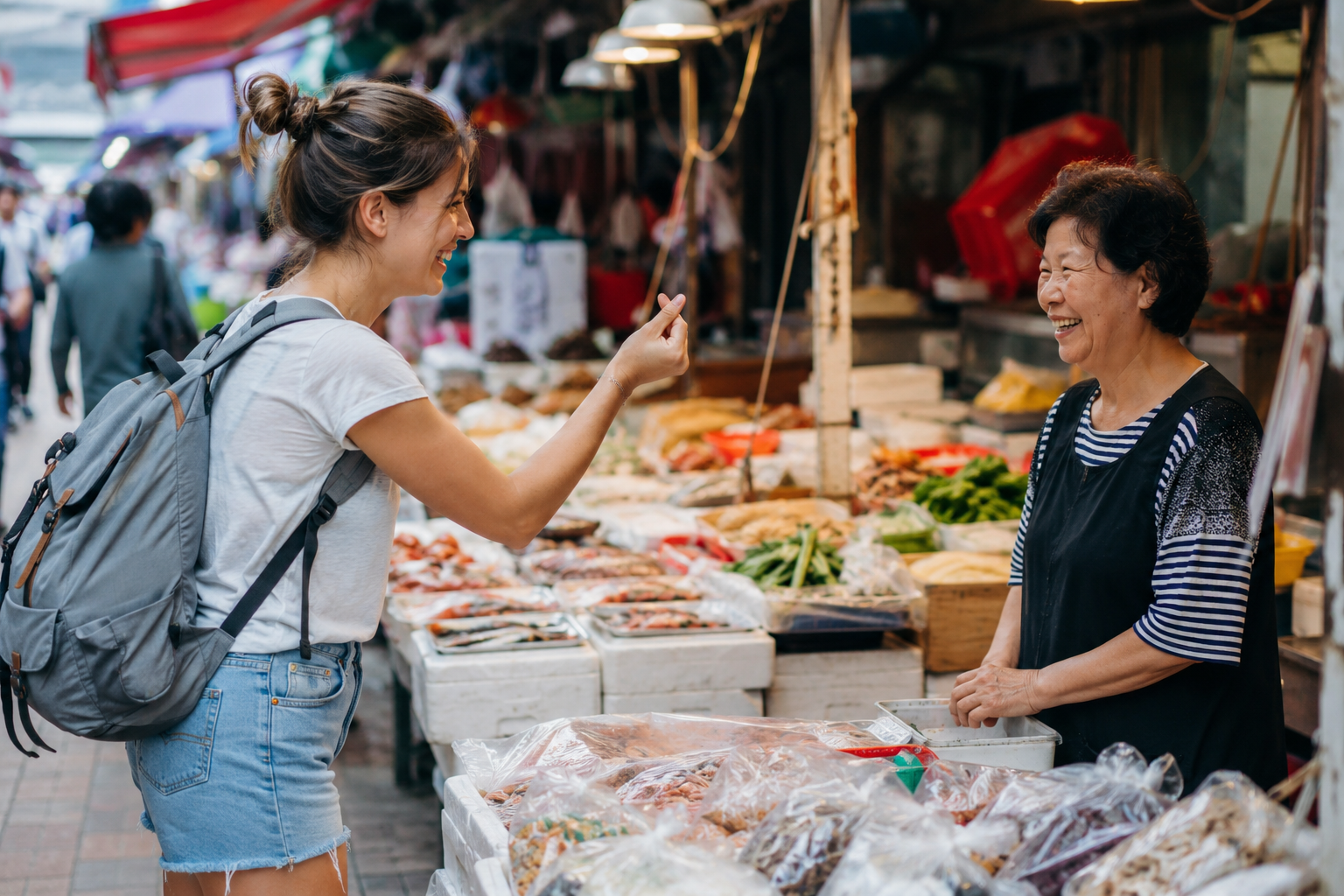
South Korea has gone from a hidden gem to one of the world’s most exciting travel destinations.
The food, the culture, the temples, the skincare, the nightlife, the BBQ; there’s a reason repeat visitors exist.
Here’s what most travel guides won’t tell you upfront: Korean is not a hard language to try.
It has consistent pronunciation rules, a logical structure, and one of the most brilliant writing systems ever invented.
You don’t need to be fluent. You just need enough to open doors, and in Korea, a respectful attempt at the language opens remarkable ones.
This guide gives you every basic Korean phrase for travel you actually need, organized by real-life situation.
No filler; just the phrases, the cultural context, and the nuances that make the difference between being understood and being politely smiled at while someone reaches for their phone.
Before you Memorize a Single Phrase: The One Rule That Changes Everything
Korean society operates on a system of speech levels: formal, polite, and casual. The level you use tells people a great deal about who you are.
As a traveler, your job is simple: always use the polite/formal level with everyone you don’t know personally.
This means adding the endings -세요 (-seyo) or -습니다 (-seumnida) to everything. These endings are your social passport in Korea.
They signal respect, awareness, and effort. These three qualities will earn you genuine warmth from Koreans rather than polite tolerance.
The trap most tourists fall into: learning the casual forms because they’re shorter and easier. Annyeong instead of Annyeonghaseyo. Gomawo instead of Gamsahamnida.
In Italian or Spanish, a casual “hi” from a foreigner reads as friendly.
In Korean culture, using casual speech with strangers or service workers reads as blunt, disrespectful, or simply ignorant of how things work.
The golden rule: when in doubt, add -세요. You will never offend anyone by being too polite.
Section 1: Before You Go: Hangul Basics & Why You Should Ditch Google Translate
Learn Hangul. Seriously.
Hangul (한글), the Korean writing system, looks intimidating from the outside.
Blocks of unfamiliar symbols. But here’s the secret: it’s one of the most logically designed alphabets in the world.
King Sejong commissioned it in 1443 specifically to be learnable by ordinary people. Most people can learn to read it phonetically in two to three hours.
Why bother? Because every sign, menu, and platform display in Korea is written in Hangul.
While major tourist areas have English translations, markets, local restaurants, and anything off the main path often don’t.
Being able to sound out Hangul, even without understanding the words, helps you match what you see to what you’ve heard.
You don’t need to understand it. You just need to read it. That’s a learnable skill for a weekend.
Why Papago Beats Google Translate in Korea
This is the single most practical piece of advice for Korean travel that almost no guide mentions.
Swap Google Translate for Papago. Developed by Naver, often described as the Google of South Korea, Papago is built specifically for Korean language nuance.
It understands honorifics, context, and natural speech patterns in a way Google Translate simply doesn’t.
The problem with Google Translate in Korean:
- It frequently generates sentences using 당신 (dangsin) for “you” — a word that sounds aggressive, confrontational, or oddly intimate when used with strangers (more on this below)
- Its Romanization produces English phonetic approximations that, when spoken aloud, are unrecognizable to native speakers. Things like “chili-an-mi-da” for 죄송합니다 that bear little resemblance to how the word actually sounds
- It doesn’t account for speech level, often giving you casual forms when you need formal
Use Papago for translation. Use its audio button to hear pronunciation. Do not try to read Korean phonetics as if they were English words.
Key Pronunciation Rules
| Korean Sound | How to Say It | Example |
| ㅓ (eo) | Like “u” in “fun” — not “ee-oh” | 어디 (eodi) = “uh-dee” |
| ㅡ (eu) | Like “uh” with lips spread flat | 그냥 (geunyang) = “guh-nyang” |
| ㅐ / ㅔ (ae/e) | Short, crisp “eh” | 네 (ne) = “neh” |
| Double consonants | Sharper, more tense | 빨리 (ppalli) = sharper “p” sound |
| Final consonants | Soften slightly at word end | 밥 (bap) = soft final “p” |
The core rule: Korean pronunciation values consistency. Once you learn a sound, it applies everywhere. It’s far more regular than English.
Section 2: Greetings & Essentials
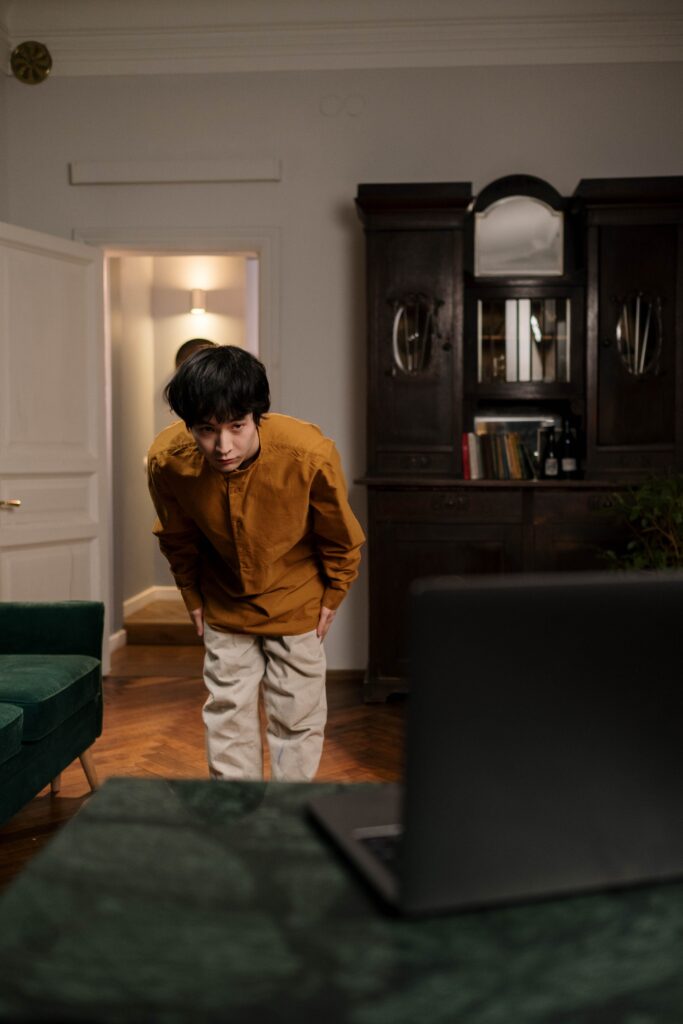
These are the foundational Korean travel phrases every tourist needs. The formality rules apply from phrase one.
| English | Korean | Romanization |
| Hello (formal — use always) | 안녕하세요 | Annyeonghaseyo |
| Goodbye (to someone leaving) | 안녕히 가세요 | Annyeonghi gaseyo |
| Goodbye (when you are leaving) | 안녕히 계세요 | Annyeonghi gyeseyo |
| Thank you (formal) | 감사합니다 | Gamsahamnida |
| Thank you (slightly casual) | 고마워요 | Gomawoyo |
| You’re welcome | 천만에요 | Cheonmaneyo |
| Excuse me (to get attention) | 실례합니다 | Sillyehamnida |
| I’m sorry | 죄송합니다 | Joesonghamnida |
| Yes | 네 | Ne |
| No | 아니요 | Aniyo |
| It’s okay / No problem | 괜찮아요 | Gwaenchanayo |
| I don’t understand | 모르겠어요 | Moreugesseoyo |
| Please (with a request) | 주세요 | Juseyo |
| Nice to meet you | 처음 뵙겠습니다 | Cheoeum boepgetseumnida |
Romanization is the process of converting text or words from a non-Latin writing system (like Chinese, Japanese, or Arabic) into the Roman (Latin) alphabet.

It helps bridge language barriers by allowing readers to sound out or spell words using the standard English/Latin alphabet.
The “You” Trap: Strike This Word Entirely
Here’s a mistake that’s more common than you’d think: typing “Do you speak English?” into Google Translate and getting back a sentence with 당신 (dangsin), the Korean word for “you.”
Do not use 당신 with strangers. Ever.
In English, “you” is neutral. In Korean, 당신 is used between married couples, in heated arguments, or when someone is being confrontational.
Saying it to a shopkeeper or waiter feels abrasive and strange. It is similar to addressing someone as “hey, you.“
The solution is elegantly simple: Korean is an omission-based language. Drop the pronoun entirely. Context does the work.
Instead of “Do you speak English?”, just say:
영어 하세요? (Yeong-eo haseyo?) means “Speak English?” The implied subject is obvious from your eye contact.
| English | Korean | Romanization |
| Do you speak English? | 영어 하세요? | Yeong-eo haseyo? |
| Please speak slowly | 천천히 말해 주세요 | Cheoncheonhi malhae juseyo |
| Can you write it down? | 적어 주세요 | Jeogeo juseyo |
| Can you help me? | 도와주실 수 있어요? | Dowajusil su isseoyo? |
| Can you repeat that? | 다시 말해 주세요 | Dasi malhae juseyo |
| I don’t speak Korean | 한국어를 못해요 | Hangugeo-reul motaeyo |
| I’m looking for… | …을/를 찾고 있어요 | …eul/reul chatgo isseoyo |
Section 3: Asking for Directions
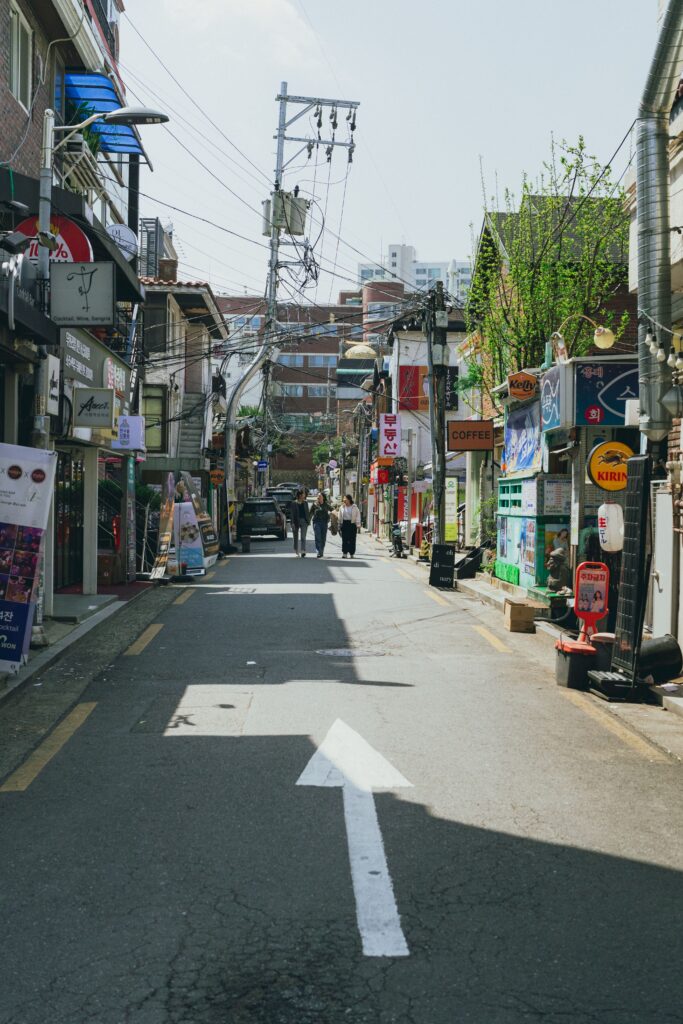
Seoul and other Korean cities are easy to navigate. First, however, there is one crucial piece of practical advice first.
Google Maps does not work reliably in South Korea. Due to mapping data restrictions, Google Maps often can’t give turn-by-turn directions within Korea.
Use Naver Maps (available in English) or Kakao Maps instead. Download one before your trip.
| English | Korean | Romanization |
| Where is…? | …이/가 어디예요? | …i/ga eodiyeyo? |
| How do I get to…? | …에 어떻게 가요? | …e eotteoke gayo? |
| Left | 왼쪽 | Oenjjok |
| Right | 오른쪽 | Oreunjjok |
| Straight ahead | 직진 | Jikjin |
| Turn | 돌아가세요 | Doragaseyo |
| Near / Far | 가까워요 / 멀어요 | Gakkawoyo / Meoreoyo |
| Here / There | 여기 / 저기 | Yeogi / Jeogi |
| At the corner | 코너에서 | Koneo-eseo |
| Traffic light | 신호등 | Sinhodeung |
| Crosswalk | 횡단보도 | Hoengdan-bodo |
| I’m lost | 길을 잃었어요 | Gireul ireosseoyo |
Pro tip: Combine a map screenshot with pointing gestures. Most Koreans who don’t speak English will still try their best to help. Many will even walk part of the way with you.
Section 4: Transport: Subway, Bus, Taxi & T-Money
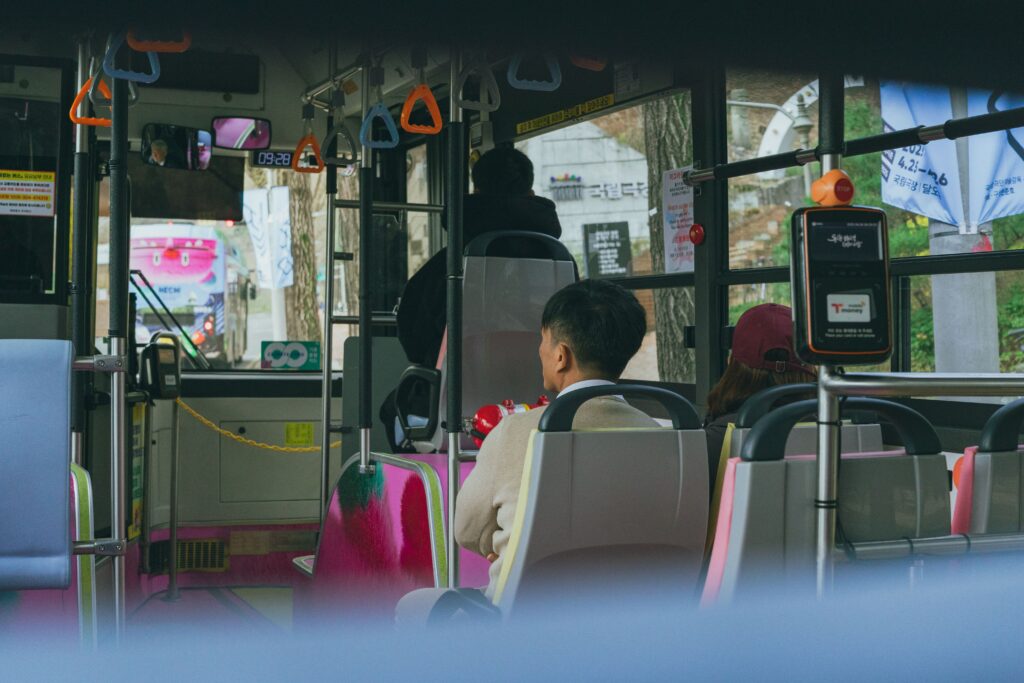
Korea’s public transport is outstanding. Seoul’s subway alone has 9+ lines, runs on time, and has English signage throughout.
The key to using it smoothly is the T-money card.
The T-Money Card
T-money is a rechargeable transit card that works on subways, buses, and many taxis across Korea. Buy one at any convenience store or airport arrival hall.
Top it up at subway station machines or convenience stores. It’s faster, cheaper (transit discount vs. single tickets), and essential.
| English | Korean | Romanization |
| Where is the subway station? | 지하철역이 어디예요? | Jihacheol-yeogi eodiyeyo? |
| Where is the bus stop? | 버스 정류장이 어디예요? | Beoseu jeongnyujangi eodiyeyo? |
| One ticket please | 표 한 장 주세요 | Pyo han jang juseyo |
| Does this bus go to…? | 이 버스가 …에 가요? | I beoseuga …e gayo? |
| I’d like to get off here | 여기서 내려주세요 | Yeogiseo naeryeojuseyo |
| How long does it take? | 얼마나 걸려요? | Eolmana geollyeoyo? |
| Do I need to transfer? | 환승해야 해요? | Hwanseunghaeya haeyo? |
| Please top up my T-money | 티머니 충전해 주세요 | T-money chungjeonhae juseyo |
Taxi Phrases
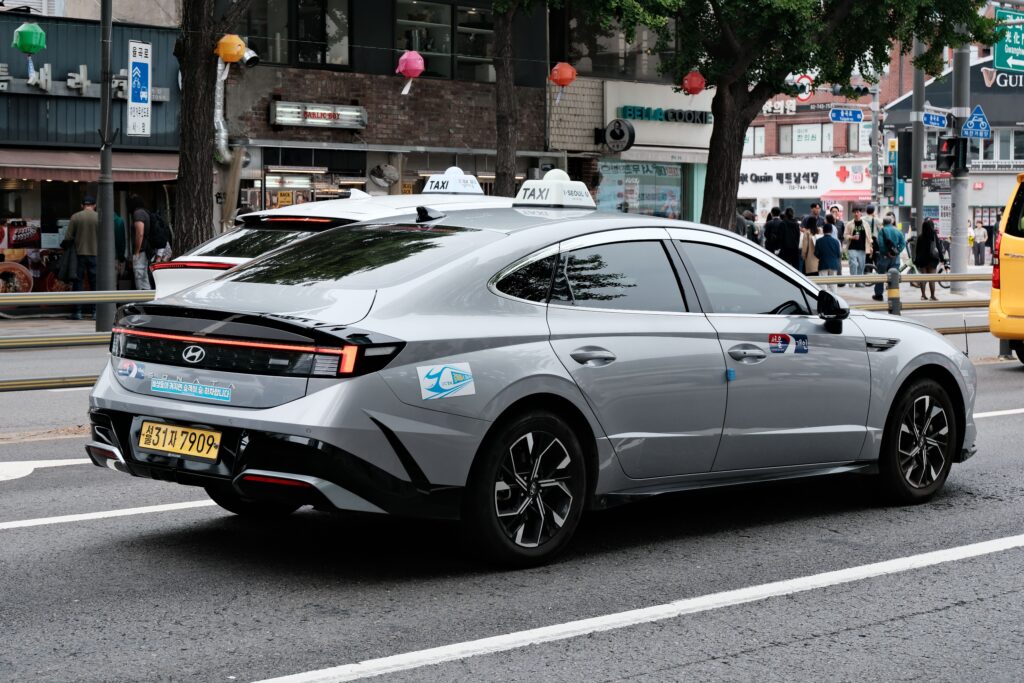
Taxis in Korea are affordable, safe, and widely available. Kakao Taxi (app) is the local equivalent of Uber and the safest way to book one.
| English | Korean | Romanization |
| Please take me to… | …에 가주세요 | …e gajuseyo |
| Please go to the airport | 공항에 가주세요 | Gonghang-e gajuseyo |
| How much to…? | …까지 얼마예요? | …kkaji eolmayeyo? |
| Please stop here | 여기서 세워 주세요 | Yeogiseo sewo juseyo |
| Please give me a receipt | 영수증 주세요 | Yeongsujeung juseyo |
Section 5: Airport & Arrival Phrases
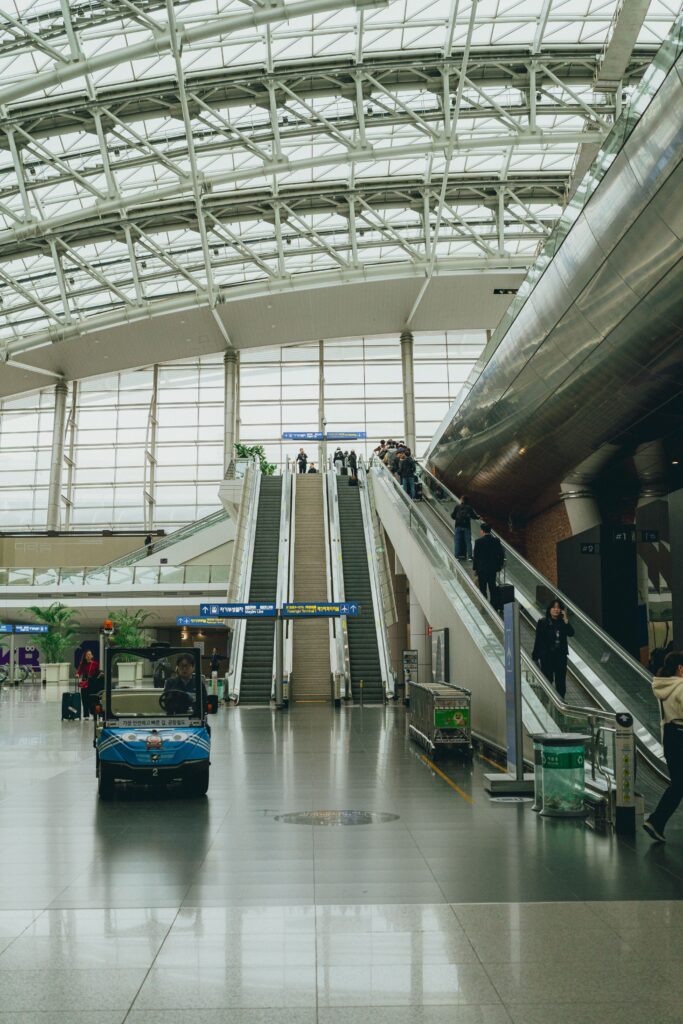
Incheon International Airport (ICN) is regularly ranked the world’s best airport. It’s well-signposted in English, but these phrases help when you need assistance.
| English | Korean | Romanization |
| Where is immigration? | 입국 심사가 어디예요? | Ipguk simsaga eodiyeyo? |
| Where is baggage claim? | 수하물 찾는 곳이 어디예요? | Suhamul chatneun gosi eodiyeyo? |
| My luggage is lost | 제 짐을 잃어버렸어요 | Je jimeul ireobeoryeosseoyo |
| Where is the airport train? | 공항철도가 어디예요? | Gonghang-cheoldoga eodiyeyo? |
| Where can I buy a T-money card? | 티머니 카드 어디서 사요? | T-money kadeu eodiseo sayo? |
| Where is the exit? | 출구가 어디예요? | Chulguga eodiyeyo? |
| Where is the tourist information? | 관광 안내소가 어디예요? | Gwangwang annaesoga eodiyeyo? |
Section 6: Korean BBQ Phrases: A Section That Actually Needs to Exist
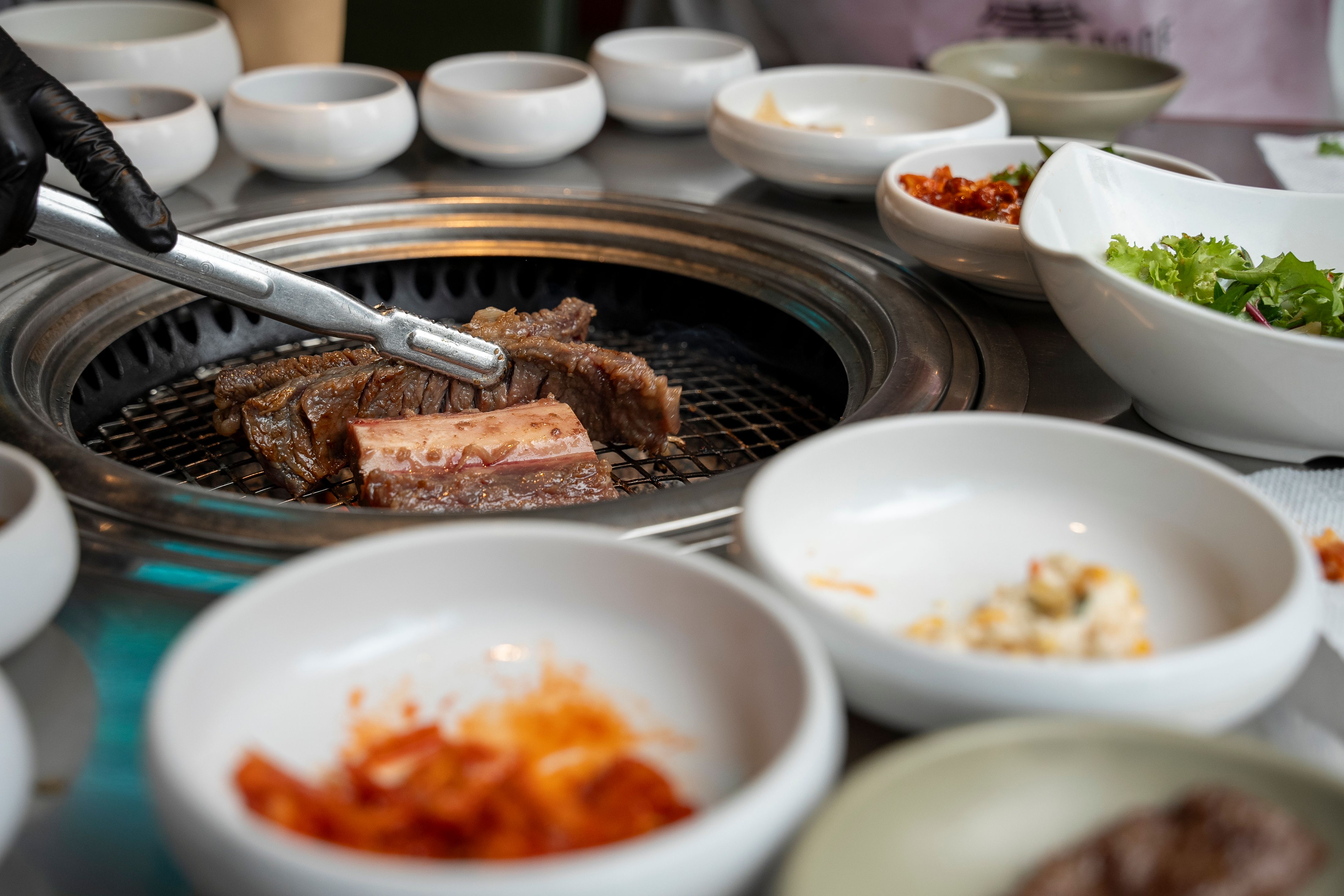
Korean barbecue is not just a meal. It is an experience, and for many travelers, it’s the highlight of their entire trip.
Marinated meats, table grills, banchan (side dishes), ssamjang sauce, wrapping leaves. Getting it right matters.
| English | Korean | Romanization |
| Please give us the menu | 메뉴 주세요 | Menyu juseyo |
| We’ll have two servings of samgyeopsal | 삼겹살 2인분 주세요 | Samgyeopsal i-inbun juseyo |
| Please change the grill | 불판 갈아 주세요 | Bulpan gara juseyo |
| Please cut the meat | 고기 잘라 주세요 | Gogi jalla juseyo |
| Can I have more lettuce wraps? | 쌈 더 주세요 | Ssam deo juseyo |
| Can I have more side dishes? | 반찬 더 주세요 | Banchan deo juseyo |
| One more serving please | 1인분 더 주세요 | Ilinbun deo juseyo |
| It’s delicious | 맛있어요 | Massisseoyo |
| Please give us scissors | 가위 주세요 | Gawi juseyo |
| Can I get some ssamjang? | 쌈장 주세요 | Ssamjang juseyo |
3 KBBQ Customs Every Traveler Should Know
1. Call the server with 저기요! (Jeogiyo!)
This phrase means “Excuse me!” and is the standard, polite way to get a server’s attention. Simply say it toward the server when you need assistance. If your table has a buzzer, which is common in many restaurants, you can press that instead.
2. The youngest person at the table grills. Or the most eager. There’s no strict rule for foreigners, but offering to manage the grill is seen as generous and engaged.
3. Pour drinks for others, not yourself. Pouring your own drink, especially alcohol, is considered poor form at a Korean table. Pour for your companions first, and they’ll return the gesture.
Section 7: Restaurant & Dining Phrases
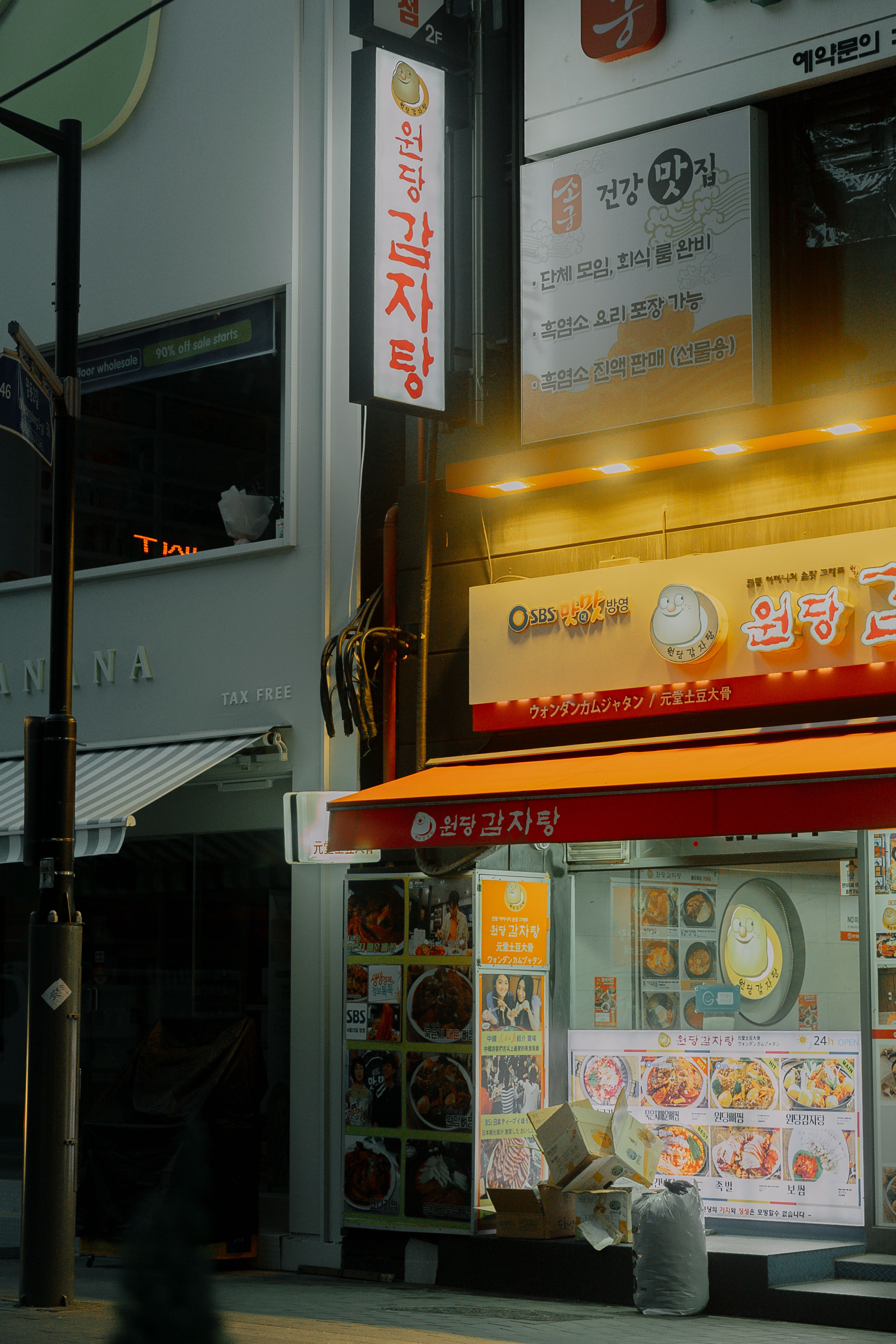
How Paying Works in Korean Restaurants. This Will Surprise You
One of the most useful pieces of knowledge for dining in Korea: you almost never pay at the table.
In most Korean restaurants, when you’re done eating, you simply stand up, walk to the cash register near the exit, and pay there.
There’s no waiting for a server to bring the bill. Some places put a slip on your table when the food arrives — take that slip to the register.
Others have no slip at all; the staff track your table.
The phrase “계산서 주세요” (bill please) exists, but most experienced Korea travelers rarely need it. Just walk to the register.
The one phrase you will need if splitting costs:
반반해 주세요 (Banban-hae juseyo) — “Please split it half and half.”
| English | Korean | Romanization |
| Excuse me! (calling server) | 저기요! | Jeogiyo! |
| Please give me the menu | 메뉴 주세요 | Menyu juseyo |
| I’d like to order | 주문할게요 | Jumunhalgeyo |
| Please give me this | 이거 주세요 | Igeo juseyo |
| What do you recommend? | 뭐가 맛있어요? | Mwoga massisseoyo? |
| Please make it less spicy | 덜 맵게 해주세요 | Deol mepge haejuseyo |
| Is this spicy? | 이게 매워요? | Ige maewoyo? |
| Please make it not spicy | 안 맵게 해주세요 | An mepge haejuseyo |
| Water please | 물 주세요 | Mul juseyo |
| More rice please | 밥 더 주세요 | Bap deo juseyo |
| I’ll eat well (before meal) | 잘 먹겠습니다 | Jal meokgetseumnida |
| I ate well (after meal) | 잘 먹었습니다 | Jal meogeosseumnida |
| Please split it half and half | 반반해 주세요 | Banban-hae juseyo |
| I’ll pay by card | 카드로 할게요 | Kadeuro halgeyo |
| I’ll pay in cash | 현금으로 할게요 | Hyeongeumero halgeyo |
Dietary Needs and Food Preferences
| English | Korean | Romanization |
| I have an allergy to… | 저는 …에 알레르기가 있어요 | Jeoneun …e allereugi-ga isseoyo |
| I’m vegetarian | 저는 채식주의자예요 | Jeoneun chaesikjuuijayeyo |
| I’m vegan | 저는 비건이에요 | Jeoneun bigeonieyo |
| I eat lactose-free | 저는 유제품을 못 먹어요 | Jeoneun yujepum-eul mot meogeoyo |
| I eat gluten-free | 저는 글루텐을 못 먹어요 | Jeoneun geulluten-eul mot meogeoyo |
| I am pescatarian | 저는 생선은 먹어요, 고기는 안 먹어요 | Jeoneun saengseon-eun meogeoyo, gogi-neun an meogeoyo |
| No meat please | 고기 빼주세요 | Gogi ppaejuseyo |
| No shellfish please | 해산물 빼주세요 | Haesanmul ppaejuseyo |
| I’m allergic to… | …에 알레르기가 있어요 | …e allereugi-ga isseoyo |
| Is there peanuts in this? | 이게 땅콩이 들어 있어요? | Ige ttangkongi deureo isseoyo? |
| No gluten please | 글루텐 빼주세요 | Geulluten ppaejuseyo |
| I don’t drink alcohol | 저는 술을 안 마셔요 | Jeoneun sul-eul an masyeoyo |
| Milk | 우유 | Uyu |
| Eggs | 달걀 | Dalgyal |
| Butter | 버터 | Beoteo |
| Gluten / Wheat | 글루텐 / 밀 | Geulluten / Mil |
Questions to Ask at the Restaurant
| English | Korean | Romanization |
| Do you have vegetarian options? | 채식 메뉴가 있어요? | Chaesik menyu-ga isseoyo? |
| Do you have gluten-free options? | 글루텐 없는 메뉴가 있어요? | Geulluten eomneun menyu-ga isseoyo? |
| Do you have lactose-free options? | 유제품 없는 메뉴가 있어요? | Yujepum eomneun menyu-ga isseoyo? |
| Do you have non-alcoholic drinks? | 무알코올 음료가 있어요? | Mualko-ol eumnyo-ga isseoyo? |
| Does this dish contain milk? | 이 음식에 우유가 들어 있어요? | I eumsik-e uyu-ga deureo isseoyo? |
| Does this dish contain eggs? | 이 음식에 달걀이 들어 있어요? | I eumsik-e dalgyal-i deureo isseoyo? |
| Does this dish contain butter? | 이 음식에 버터가 들어 있어요? | I eumsik-e beoteo-ga deureo isseoyo? |
The Spicy Food Crisis: What Actually Works
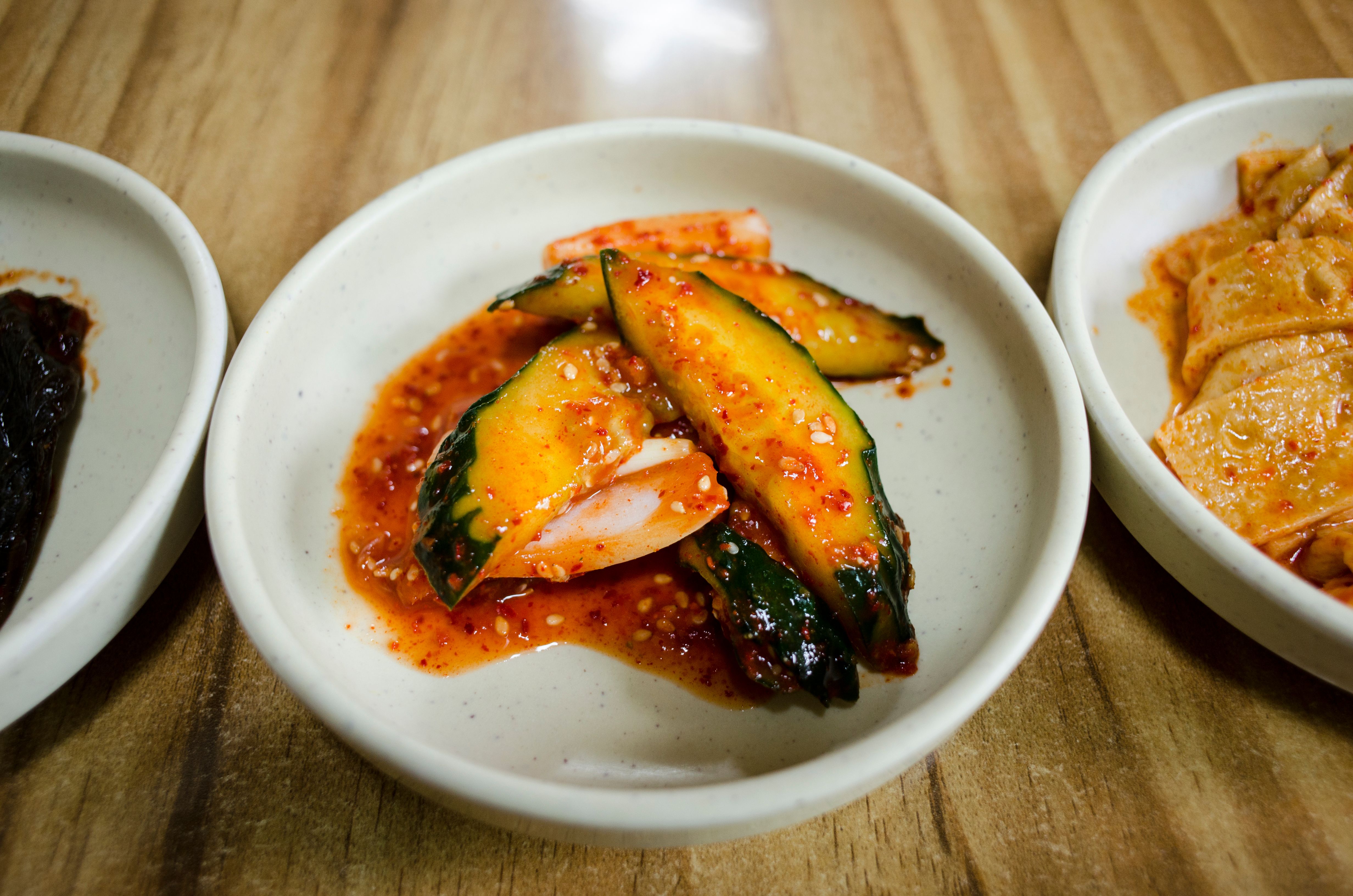
Korean cuisine is famous for its heat, and 매운 (maeun / spicy) is a flavor category taken seriously. Here’s your practical toolkit:
- Before ordering: “이게 매워요?” (Ige maewoyo?) means “Is this spicy?” + use an X-motion with your arms if needed for emphasis
- When ordering: “덜 맵게 해주세요” (Deol mepge haejuseyo) means “Please make it less spicy”
- Zero spice: “안 맵게 해주세요” (An mepge haejuseyo) means “Please make it not spicy”
- On the menu: Look for 순한맛 (sunhan mat) means “mild flavor” options
Section 8: Café, Street Food & Convenience Store Phrases
Café Culture
Korea’s café scene is world-class. It combines beautiful spaces, exceptional coffee, and a culture of lingering for hours.
Baristas take pride in their craft and are used to detailed orders.
| English | Korean | Romanization |
| One Americano please | 아메리카노 한 잔 주세요 | Amerikano han jan juseyo |
| One latte please | 라떼 한 잔 주세요 | Ratteu han jan juseyo |
| Hot / Iced | 따뜻한 것 / 아이스 | Ttattteutan geot / Aisseu |
| Less sweet please | 덜 달게 해주세요 | Deol dalge haejuseyo |
| For here / To go | 여기서 마실게요 / 가져갈게요 | Yeogiseo masilgeyo / Gajyeogalgeyo |
| Can I use the WiFi? | 와이파이 쓸 수 있어요? | Waipai sseul su isseoyo? |
| What’s the WiFi password? | 와이파이 비밀번호가 뭐예요? | Waipai bimilbeonhoga mwoyeyo? |
Street Food
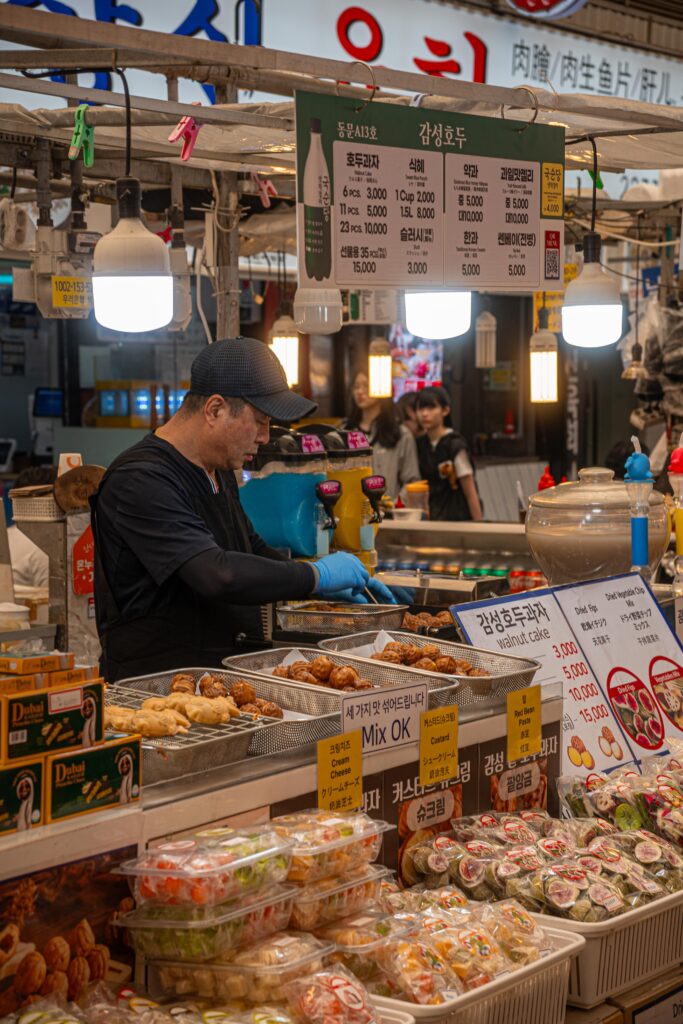
| English | Korean | Romanization |
| Spicy rice cakes please | 떡볶이 주세요 | Tteokbokki juseyo |
| Fried chicken please | 치킨 주세요 | Chikin juseyo |
| Sweet pancake please | 호떡 주세요 | Hotteok juseyo |
| Fish cake please | 어묵 주세요 | Eomuk juseyo |
| How much is one? | 하나에 얼마예요? | Hana-e eolmayeyo? |
Convenience Stores (편의점 — Pyeonicjeom)
7-Eleven, CU, GS25, and Emart24 are embedded in Korean daily life. As a traveler, you’ll visit them constantly for meals, snacks, drinks, and practical needs.
| English | Korean | Romanization |
| Can I heat this up? | 이거 데워 주세요 | Igeo dewo juseyo |
| Do you have a bag? | 봉투 있어요? | Bongtu isseoyo? |
| Can I top up my T-money here? | 여기서 티머니 충전돼요? | Yeogiseo T-money chungjeondwaeyo? |
| Do you have a phone charger? | 충전기 있어요? | Chungjeongi isseoyo? |
| Where are the chopsticks? | 젓가락 어디 있어요? | Jeotgarak eodi isseoyo? |
Section 9: K-Beauty & Shopping Phrases
Korea is a global beauty destination. Olive Young, Innisfree, Etude House, and the Myeongdong street vendors attract millions of visitors specifically to shop.
K-Beauty Shopping
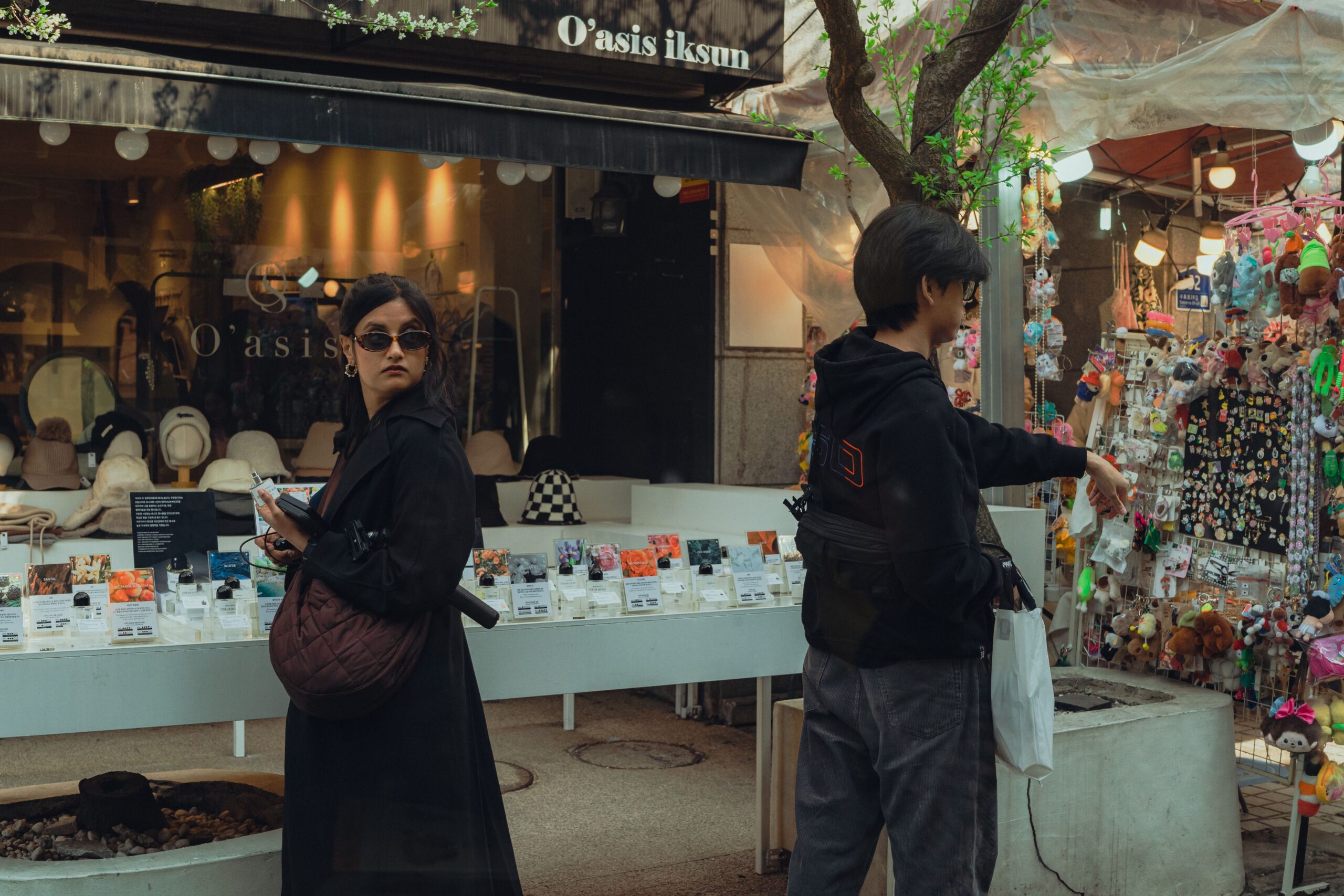
| English | Korean | Romanization |
| Do you have a sample? | 샘플 있어요? | Saempeul isseoyo? |
| What’s good for dry skin? | 건성 피부에 뭐가 좋아요? | Geonseong pibu-e mwoga joayo? |
| What’s good for oily skin? | 지성 피부에 뭐가 좋아요? | Jiseong pibu-e mwoga joayo? |
| I have sensitive skin | 민감성 피부예요 | Mingamseong pibuyeyo |
| I’m looking for sunscreen | 선크림 찾고 있어요 | Seonkeurim chatgo isseoyo |
| Do you have this in another color? | 다른 색 있어요? | Dareun saek isseoyo? |
| Can I try this? | 이거 발라봐도 돼요? | Igeo balrabwado dwaeyo? |
| Is this a popular item? | 이게 인기 있는 거예요? | Ige ingi inneun geoyeyo? |
| I’ll take this | 이거 살게요 | Igeo salgeyo |
| Can I get a tax refund? | 세금 환급 돼요? | Segeum hwangeup dwaeyo? |
General Shopping
| English | Korean | Romanization |
| How much is this? | 이거 얼마예요? | Igeo eolmayeyo? |
| It’s too expensive | 너무 비싸요 | Neomu bissayo |
| Can you give me a discount? | 깎아 주세요 | Kkakka juseyo |
| Can I try this on? | 입어봐도 돼요? | Ibobwado dwaeyo? |
| Do you have other sizes? | 다른 사이즈 있어요? | Dareun saijeu isseoyo? |
| Do you accept cards? | 카드 돼요? | Kadeu dwaeyo? |
| Please give me a receipt | 영수증 주세요 | Yeongsujeung juseyo |
| I’m just looking | 그냥 보는 거예요 | Geunyang boneun geoyeyo |
Shopping note: Bargaining is expected at traditional markets (Namdaemun, Dongdaemun). Fixed prices at department stores and brand shops.
In Myeongdong, vendors approach you — “괜찮아요” (gwaenchanayo) said with a smile means “I’m fine, thanks” and is a polite way to decline without rudeness.
Section 10: Accommodation Phrases
| English | Korean | Romanization |
| I have a reservation | 예약했어요 | Yeyakhaesseoyo |
| My name is… | 제 이름은 …이에요 | Je ireumeun …ieyo |
| Is breakfast included? | 조식 포함이에요? | Josik poham-ieyo? |
| What time is check-out? | 체크아웃이 몇 시예요? | Chekeuaus-i myeot si-yeyo? |
| Can I get a late check-out? | 늦은 체크아웃 되나요? | Neujeun chekeuaus doenayo? |
| The room is too hot/cold | 방이 너무 더워요/추워요 | Bangi neomu deowoyo/chuwoyo |
| The WiFi isn’t working | 와이파이가 안 돼요 | Waipai-ga an dwaeyo |
| Can I get extra towels? | 수건 더 주세요 | Sugeon deo juseyo |
| Where is the elevator? | 엘리베이터가 어디예요? | Elribeiteoga eodiyeyo? |
| What is the WiFi password? | 와이파이 비밀번호가 뭐예요? | Waipai bimilbeonhoga mwoyeyo? |
Section 11: Jimjilbang: Korean Sauna & Bathhouse Phrases
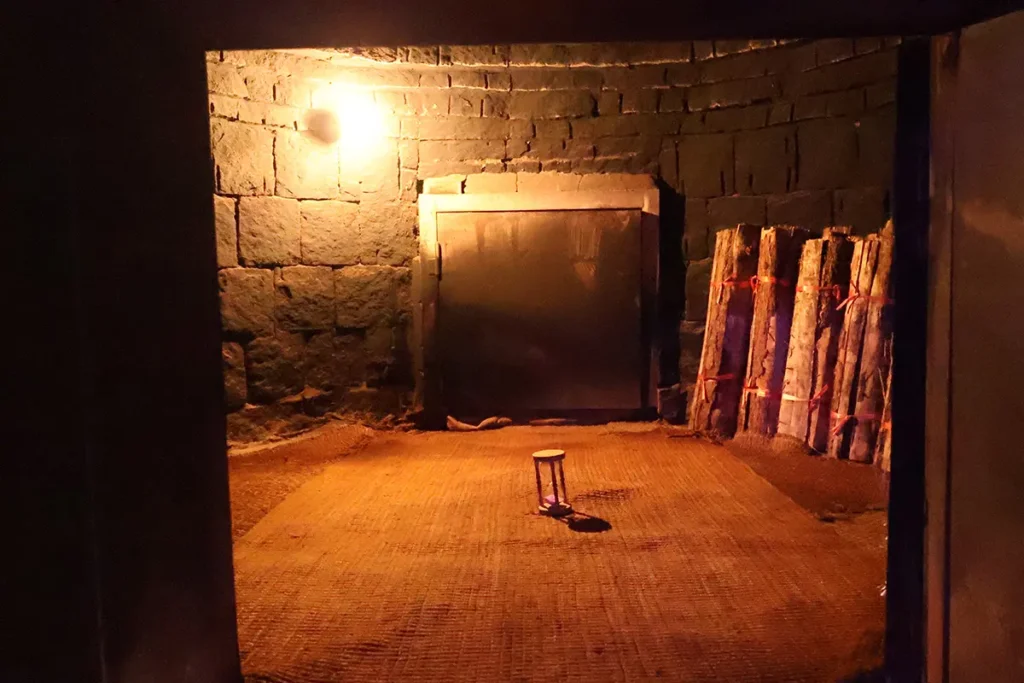
The jimjilbang (찜질방) is one of Korea’s most distinctive cultural experiences and something every traveler should try at least once.
These are large public bathhouses with gender-separated bathing areas, heated rooms at various temperatures, sleeping areas, restaurants, and entertainment, often open 24 hours.
| English | Korean | Romanization |
| Where is the jimjilbang? | 찜질방이 어디예요? | Jjimjilbangi eodiyeyo? |
| How much is the entrance fee? | 입장료가 얼마예요? | Ipjangnyo-ga eolmayeyo? |
| Can I rent a towel? | 수건 빌릴 수 있어요? | Sugeon billil su isseoyo? |
| Can I rent a locker? | 보관함 빌릴 수 있어요? | Bogwanham billil su isseoyo? |
| Where are the hot rooms? | 찜질방이 어디에 있어요? | Jjimjilbangi eodie isseoyo? |
| Where are the showers? | 샤워실이 어디예요? | Syawosili eodiyeyo? |
| One sikhye please | 식혜 주세요 | Sikhye juseyo |
| One boiled egg please | 계란 주세요 | Gyeran juseyo |
Jimjilbang basics: Tattoos may be restricted at some traditional jimjilbangs, check before going. Provided uniforms (shorts and t-shirt) are standard in the common areas.
Bathing areas are gender-separated and clothing-free (this is completely normal and expected).
Section 12: Norebang: Karaoke Phrases
Norebang (노래방) is private-room karaoke, one of the most popular social activities in Korea for locals and tourists alike.
You rent a private room by the hour with your group, order drinks and snacks, and sing without an audience. No stage fright required.
| English | Korean | Romanization |
| Where is the norebang? | 노래방이 어디예요? | Norebangi eodiyeyo? |
| How much per hour? | 한 시간에 얼마예요? | Han sigan-e eolmayeyo? |
| We’d like a room for … people | …명이요 | …myeongiyo |
| Can we extend our time? | 시간 연장할 수 있어요? | Sigan yeonjanghal su isseoyo? |
| Please give us tambourines | 탬버린 주세요 | Taemberrin juseyo |
| Can I order food? | 음식 주문할 수 있어요? | Eumsik jumunhal su isseoyo? |
Norebang tip: Tambourines are standard equipment and using them enthusiastically is not optional, it is expected.
Section 13: Temples & Palace Phrases
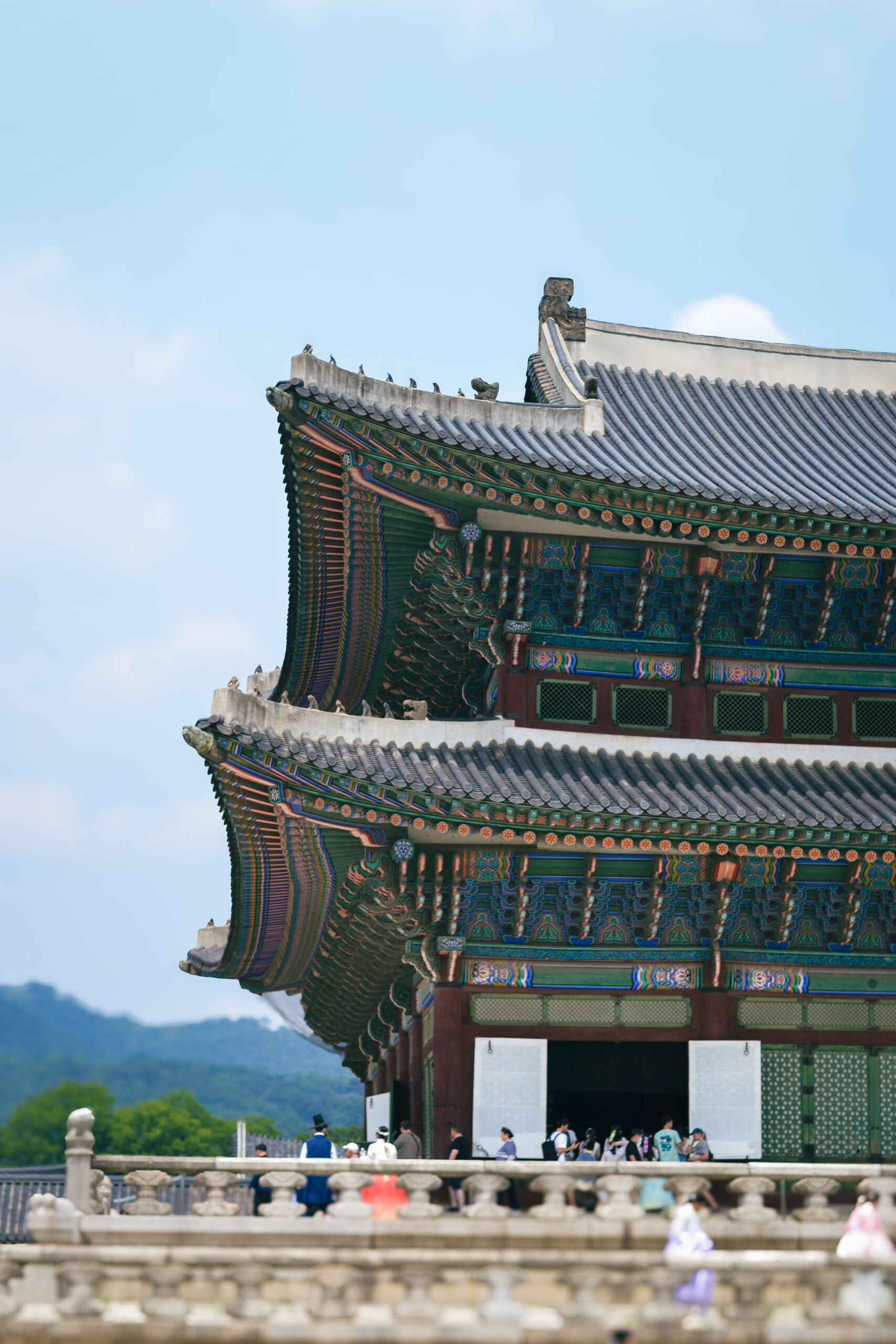
Korea’s Buddhist temples and Joseon-era palaces are among the most visited attractions.
Places such as Gyeongbokgung, Changdeokgung, Bulguksa, and Jogyesa each have their own etiquette rules.
| English | Korean | Romanization |
| One adult ticket please | 어른 한 명이요 | Eoreun han myeongiyo |
| Is there an English audio guide? | 영어 오디오 가이드 있어요? | Yeong-eo odio gaideu isseoyo? |
| When does it open/close? | 몇 시에 열어요/닫아요? | Myeot si-e yeoreoyo/dadayo? |
| Is photography allowed? | 사진 찍어도 돼요? | Sajin jjigeodo dwaeyo? |
| Where is the main hall? | 본당이 어디예요? | Bondangi eodiyeyo? |
| Where is the entrance? | 입구가 어디예요? | Ipguga eodiyeyo? |
Temple etiquette: Dress modestly (shoulders and knees covered). Bow slightly when passing monks. Be quiet inside worship halls. Do not step on the threshold of temple doors, step over it.
Section 14: Korean Holiday Phrases to Know for Travelers
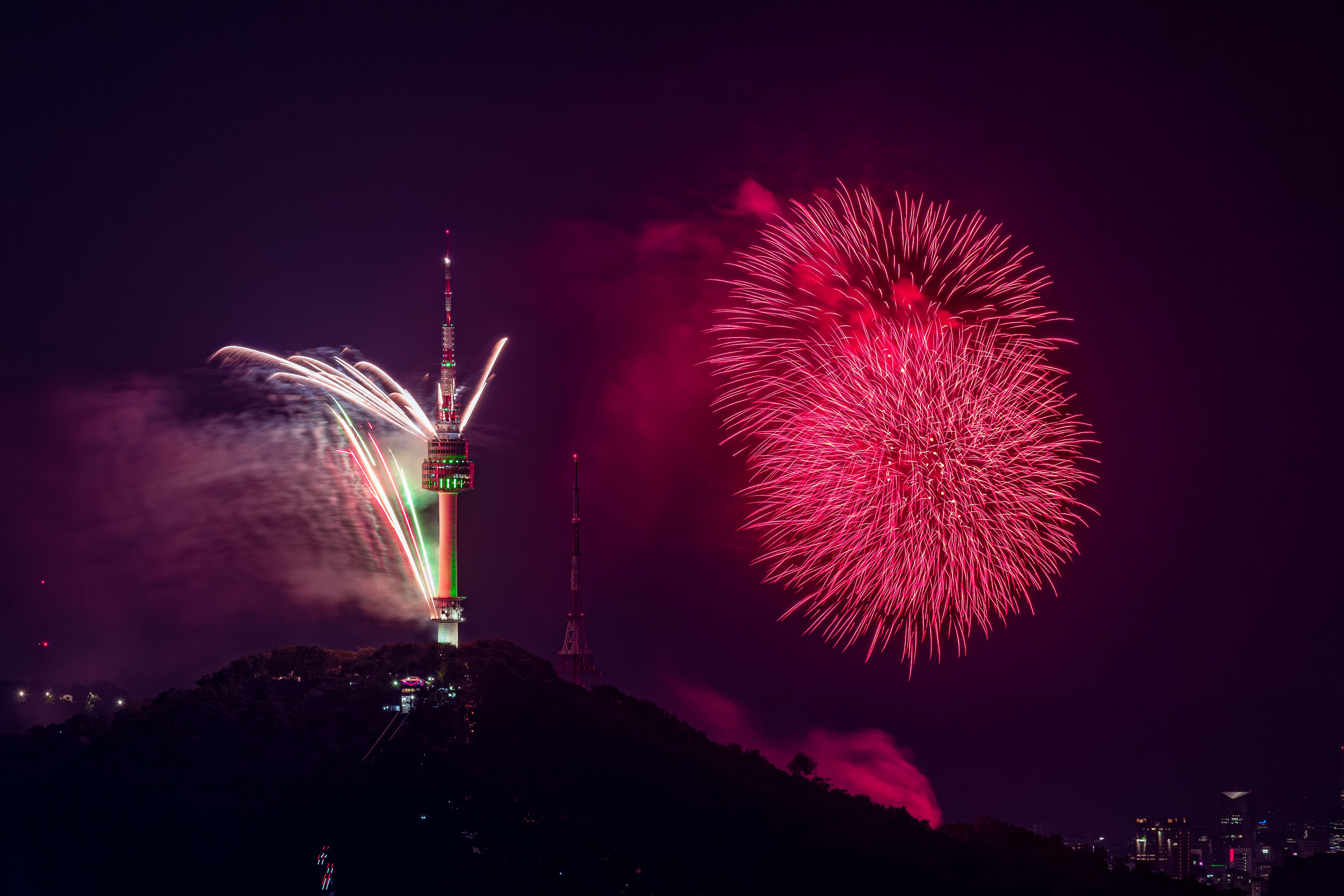
Knowing a few Korean celebration phrases goes a long way.
Koreans celebrate holidays with great enthusiasm, and using even one of these phrases at the right moment will genuinely surprise and delight locals.
| English | Korean | Romanization |
|---|---|---|
| Happy New Year | 새해 복 많이 받으세요 | Saehae bok mani badeuseyo |
| Happy Chuseok (Harvest Festival) | 즐거운 추석 보내세요 | Jeulgeoun Chuseok bonaeseyo |
| Happy Seollal (Lunar New Year) | 새해 복 많이 받으세요 | Saehae bok mani badeuseyo |
| Merry Christmas | 메리 크리스마스 | Meri Keuriseumaseu |
| Happy Birthday | 생일 축하합니다 | Saengil chukahamnida |
| Congratulations | 축하합니다 | Chukahamnida |
| Have a good holiday | 즐거운 휴일 보내세요 | Jeulgeoun hyuil bonaeseyo |
| Wishing you happiness | 행복하세요 | Haengbokhaseyo |
Travel tip: Chuseok (추석) and Seollal (설날) are Korea's two biggest holidays. Think of them as Korean Thanksgiving and Lunar New Year respectively.

During these periods, many shops and restaurants close and transport gets extremely busy. If your trip overlaps with either, book accommodation and trains well in advance.
Section 15: For Women Travelers: Korean Phrases You Actually Need
| English | Korean | Romanization |
|---|---|---|
| Where is the nearest pharmacy? | 가장 가까운 약국이 어디예요? | Gajang gakkaun yakgugi eodiyeyo? |
| I need sanitary pads | 생리대가 필요해요 | Saengni-daega piryohaeyo |
| I need tampons | 탐폰이 필요해요 | Tamponi piryohaeyo |
| I have menstrual cramps | 생리통이 있어요 | Saengni-tongi isseoyo |
| I need pain relief | 진통제가 필요해요 | Jintongje-ga piryohaeyo |
| I need a pregnancy test | 임신 테스트가 필요해요 | Imsin teseuteu-ga piryohaeyo |
| I need to see a female doctor | 여의사 선생님께 진찰받고 싶어요 | Yeo-uisa seonsaengnim-kke jinchal-batgo sipeoyo |
| Do I need a prescription? | 처방전이 필요해요? | Cheobangjeoni piryohaeyo? |
| Leave me alone | 저 좀 내버려 두세요 | Jeo jom naebeoryeo duseyo |
| Go away | 저리 가세요 | Jeori gaseyo |
| Help! | 도와주세요! | Dowajuseyo! |
| Call the police | 경찰을 불러주세요 | Gyeongchal-eul bulleojuseyo |
| Is it safe here at night? | 여기 밤에 안전해요? | Yeogi bame anjeonhaeyo? |
Practical note: Sanitary products are widely available at all convenience stores (CU, GS25, 7-Eleven) and pharmacies across Korea.
You do not need a pharmacy specifically for these items. For medical concerns, look for the 약국 (yakguk) sign in green or red.
Section 16: Emergency & Pharmacy Phrases
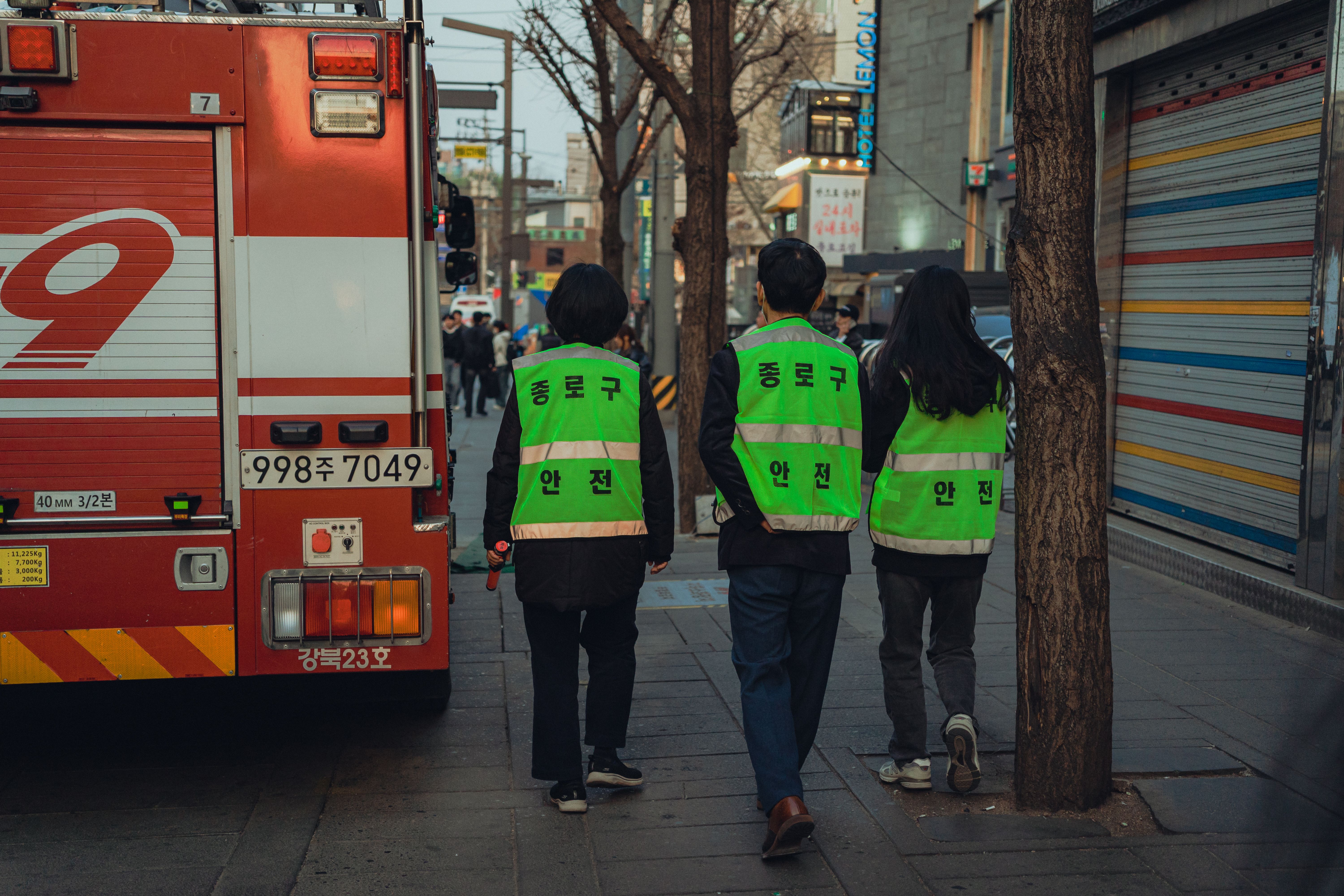
Emergency numbers in Korea:
- 112 – Police
- 119 – Fire & Ambulance
- 1330 – Korea Tourism Hotline (English-speaking operators available 24/7 — arguably the most useful number for tourists)
| English | Korean | Romanization |
| Help! | 도와주세요! | Dowajuseyo! |
| It’s an emergency | 응급상황이에요 | Eunggeup sanghwang-ieyo |
| Call the police! | 경찰 불러주세요! | Gyeongchal bulleojuseyo! |
| Call an ambulance! | 구급차 불러주세요! | Gugeupcha bulleojuseyo! |
| I need a doctor | 의사가 필요해요 | Uisaga piryohaeyo |
| Where is the hospital? | 병원이 어디예요? | Byeongwoni eodiyeyo? |
| Where is the pharmacy? | 약국이 어디예요? | Yakgugi eodiyeyo? |
| I’ve been robbed | 강도 당했어요 | Gangdo danghaesseoyo |
| I’m lost | 길을 잃었어요 | Gireul ireosseoyo |
| I’m sick | 아파요 | Apayo |
| It hurts here | 여기가 아파요 | Yeogiga apayo |
| I have a headache | 머리가 아파요 | Meoriga apayo |
| I have a fever | 열이 있어요 | Yeori isseoyo |
| I’m allergic to… | …에 알레르기가 있어요 | …e allereugi-ga isseoyo |
| Do I need a prescription? | 처방전이 필요해요? | Cheobangjeoni piryohaeyo? |
1330 Tourism Hotline: This is Korea's secret weapon for tourists.

Dial 1330 from anywhere in Korea (including mobile phones) for English-speaking assistance with anything, translation help, tourism questions, emergencies, or just being lost. Save it before your trip.
Section 17: Numbers, Time & Days
Numbers
| Number | Korean | Romanization |
| 1 | 일 | Il |
| 2 | 이 | I |
| 3 | 삼 | Sam |
| 4 | 사 | Sa |
| 5 | 오 | O |
| 6 | 육 | Yuk |
| 7 | 칠 | Chil |
| 8 | 팔 | Pal |
| 9 | 구 | Gu |
| 10 | 십 | Sip |
| 20 | 이십 | Isip |
| 100 | 백 | Baek |
| 1,000 | 천 | Cheon |
| 10,000 | 만 | Man |
Important: Korean has two counting systems: Sino-Korean (above, used for money, dates, floors) and Native Korean (used for counting objects and age). For travel, Sino-Korean handles most situations.
Telling the Time
| English | Korean | Romanization |
| What time is it? | 몇 시예요? | Myeot si-yeyo? |
| It’s … o’clock | …시예요 | …si-yeyo |
| Morning / Afternoon | 오전 / 오후 | Ojeon / Ohu |
| Noon / Midnight | 정오 / 자정 | Jeong-o / Jajeong |
Days of the Week
| English | Korean | Romanization |
| Monday | 월요일 | Woryoil |
| Tuesday | 화요일 | Hwayoil |
| Wednesday | 수요일 | Suyoil |
| Thursday | 목요일 | Mogyoil |
| Friday | 금요일 | Geumyoil |
| Saturday | 토요일 | Toyoil |
| Sunday | 일요일 | Iryoil |
| Today / Tomorrow / Yesterday | 오늘 / 내일 / 어제 | Oneul / Naeil / Eoje |
Quick-Reference Cheat Sheet
Save this for your trip.
Survival Essentials
| Situation | Korean |
| Hello | 안녕하세요 |
| Thank you | 감사합니다 |
| Excuse me / Sorry | 죄송합니다 |
| Yes / No | 네 / 아니요 |
| I don’t understand | 모르겠어요 |
| Do you speak English? | 영어 하세요? |
| Help! | 도와주세요! |
Food & Dining
| Situation | Korean |
| Excuse me! (calling server) | 저기요! |
| Please give me this | 이거 주세요 |
| Less spicy please | 덜 맵게 해주세요 |
| Is this spicy? | 이게 매워요? |
| Water please | 물 주세요 |
| Split it half and half | 반반해 주세요 |
| I’ll pay by card | 카드로 할게요 |
Getting Around
| Situation | Korean |
| Where is…? | …이/가 어디예요? |
| Subway station | 지하철역 |
| Bus stop | 버스 정류장 |
| Please stop here (taxi) | 여기서 세워 주세요 |
| I’m lost | 길을 잃었어요 |
| Please top up T-money | 티머니 충전해 주세요 |
Shopping & Beauty
| Situation | Korean |
| How much? | 얼마예요? |
| Too expensive | 너무 비싸요 |
| Discount please | 깎아 주세요 |
| Do you have a sample? | 샘플 있어요? |
| I’ll take this | 이거 살게요 |
Emergencies
| Situation | Korean |
| Police | 112 |
| Ambulance / Fire | 119 |
| Tourism hotline (English) | 1330 |
| I need a doctor | 의사가 필요해요 |
| Where is the pharmacy? | 약국이 어디예요? |
A Final Word: Korea Rewards the Effort More Than Almost Anywhere
Korean culture doesn’t expect foreigners to speak Korean.
However, people notice when visitors make an effort, and they often respond with a level of warmth that goes beyond standard tourist-industry friendliness.
A stumbled 안녕하세요 at the door of a restaurant. A 감사합니다 after getting directions. A 덜 맵게 해주세요 that makes the chef smile because you actually know the phrase. These aren’t language wins. They’re human ones.
The phrases in this guide won’t make you fluent. They’ll make you connected to the food, the places, and the people who make Korea one of the most extraordinary travel destinations on earth.
잘 여행하세요! (Jal yeohaenghaseyo!) — Have a great trip! ❤️❤️❤️
FAQ: Common Korean Phrases for Travel
1. What are the most important basic Korean phrases for tourists?
The most important single phrase is 안녕하세요 (annyeonghaseyo / hello) — used every time you enter a shop, restaurant, or interact with anyone.
After that: 감사합니다 (gamsahamnida / thank you), 죄송합니다 (joesonghamnida / excuse me/sorry), 저기요 (jeogiyo / excuse me, to call a server), and 이거 주세요 (igeo juseyo / please give me this). These five phrases cover the majority of daily tourist interactions.
2. What’s the best translation app for Korea?
Use Papago, not Google Translate. Developed by Naver, South Korea’s dominant search engine, Papago handles Korean honorifics, context, and natural speech patterns far better than Google Translate.
Critically, Google Translate often generates sentences using 당신 (dangsin) for “you,” which sounds aggressive or confrontational with strangers. Papago avoids this. Use Papago’s audio feature to hear correct pronunciation.
3. Does tipping happen in South Korea?
No. Tipping is not a custom in South Korea and is not expected at restaurants, taxis, hotels, or anywhere else. Pay the listed price, say 감사합니다, and you’re done.
Attempting to leave a tip can cause confusion and mild awkwardness.
4. How formal should I be when speaking Korean?
Always use formal/polite speech with strangers. The practical rule: make sure your sentences end in -세요 (-seyo) or -습니다 (-seumnida).
Using casual speech with shopkeepers, waiters, or anyone you’ve just met can come across as blunt or disrespectful. You’ll never offend someone by being too polite.
5. How do I call a server in a Korean restaurant?
Say 저기요! (jeogiyo!), pronounced “juh-gi-yo”, while making eye contact with the server. Many Korean restaurants also have a buzzer on the table; pressing it is equally acceptable.
Do not try to make eye contact and wait for the server to approach on their own; calling them actively is completely normal and expected.
6. How does paying work in Korean restaurants?
In most Korean restaurants, you don’t wait for a bill at the table. When you’re done eating, stand up, walk to the cash register near the exit, and pay there.
Some places place a slip on your table when the food arrives, take that to the register. To split the bill evenly, say 반반해 주세요 (banban-hae juseyo / please do half and half).
7. Do I need to learn Hangul before visiting Korea?
Not essential, but highly recommended. Hangul is one of the world’s most logical writing systems and most people can learn to read it phonetically in 2–3 hours.
Being able to sound out signs, menus, and subway stops makes navigation significantly easier, especially outside major tourist areas where English translations may be absent.
8. What should I do if I get lost or need help in Korea?
Dial 1330, the Korea Tourism Hotline. It’s available 24/7 in English (and several other languages) and can assist with translation, directions, emergencies, and general tourist questions.
Save this number before your trip. For police, call 112. For ambulance or fire, call 119.
9. What are basic Korean travel phrases for K-beauty shopping?
The essentials for Olive Young and Myeongdong: 샘플 있어요? (saempeul isseoyo? / do you have a sample?), 이거 얼마예요? (igeo eolmayeyo? / how much is this?), 민감성 피부예요 (mingamseong pibuyeyo / I have sensitive skin), 이거 살게요 (igeo salgeyo / I’ll take this), and 세금 환급 돼요? (segeum hwangeup dwaeyo? / can I get a tax refund?).
Tax refund eligibility applies to purchases over a certain amount at registered shops — look for the Tax Free sticker.